
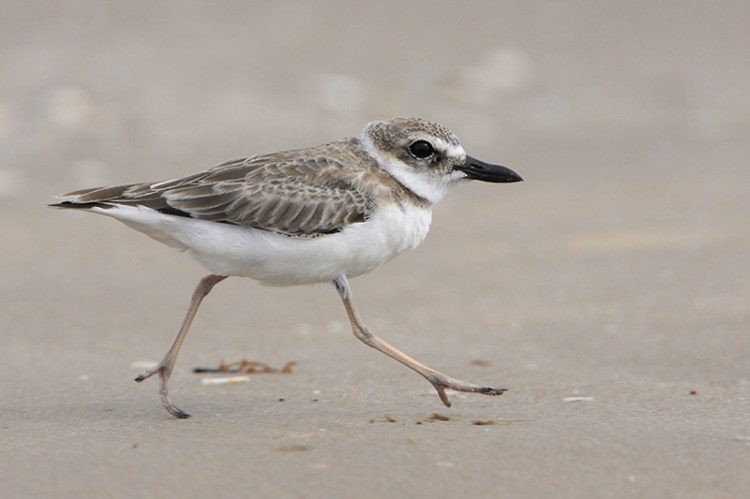
Wilson’s Plover (Charadrius wilsonia)
Family: Charadriidae
By Maria Hart
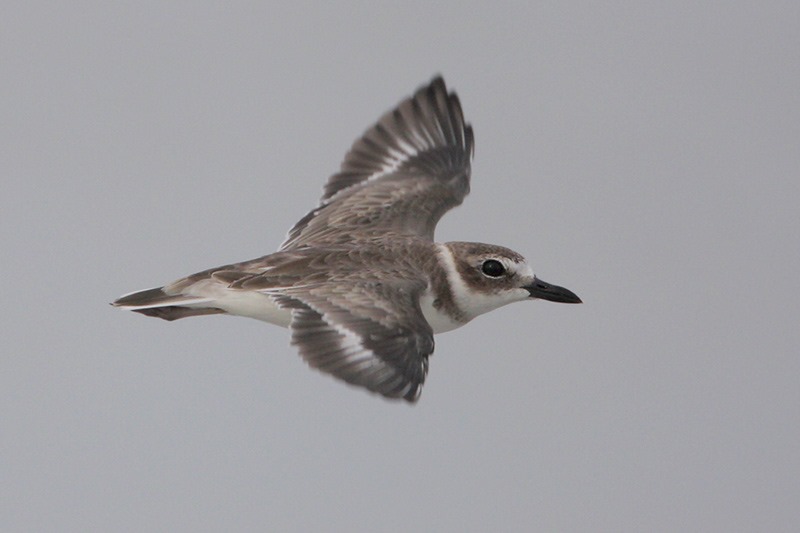
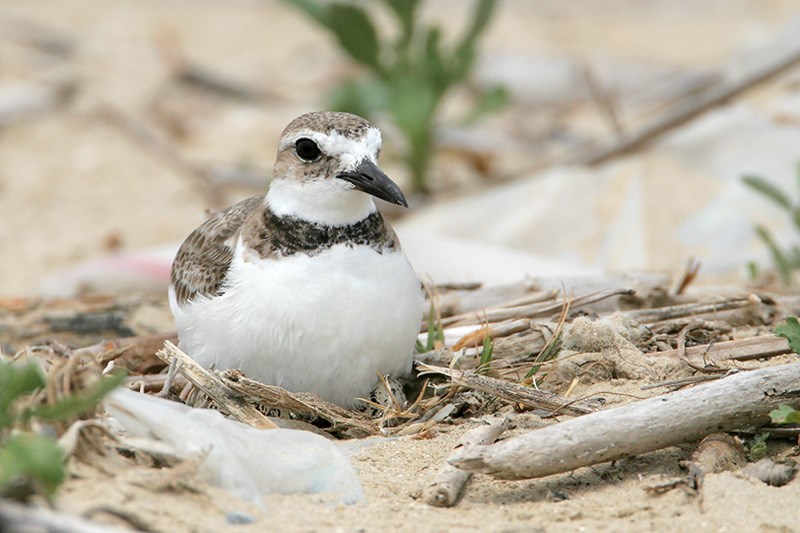
Wilson’s Plovers reside on beaches of the southern Atlantic Ocean and the Gulf Coast. They are a medium sized plover with grayish brown upper parts, white underparts, and a pale brown collar. While in breeding plumage, Wilson’s Plovers develop a thick black ring around their neck with males having a considerably larger neck ring than that of a female. While in flight look for slender wings and black on the tip of the tail. One distinguishing characteristic of this plover is their almost unproportionately thick and large black bill.
Wilson’s Plovers use this extraordinarily large bill to dine on crustaceans, specifically fiddler crabs found on intertidal salt flats, mud flats, lagoons, etc. They nest in similar areas, selecting sites within close proximity of sparse vegetation to help camouflage the eggs. Males will construct small and shallow scrapes in the sand until he forms one to the liking of his female mate. Females will then lay three small eggs in the tiny indentation. These nests blend in remarkably well with its surroundings, making it difficult for beach-goers to see until it is too late.
Beach development and recreational use is on the rise which is degrading critical habitat for many shorebirds. Due to this, Wilson’s Plover populations are in decline and the species is at risk of becoming threatened or endangered. Symbolic fencing has been erected in coastal areas such as Houston Audubon’s Bolivar Flats Shorebird Sanctuary in order to protect the nesting habitat of a variety of beach nesting birds, including Wilson’s Plovers, from pedestrians, recreational vehicles, and unleashed dogs. These shorebirds can be seen on the Texas coast all summer long so keep an eye out for Wilson’s Plovers and their chicks, and be sure to watch your step!

Visit our Bird Gallery to read about other Texas birds!
 Houston AuduBlog