

Blue-winged Teal (Spatula discors)
Family: Anatidae
By Rachel Myers, Houston Audubon Coastal Conservation Technician
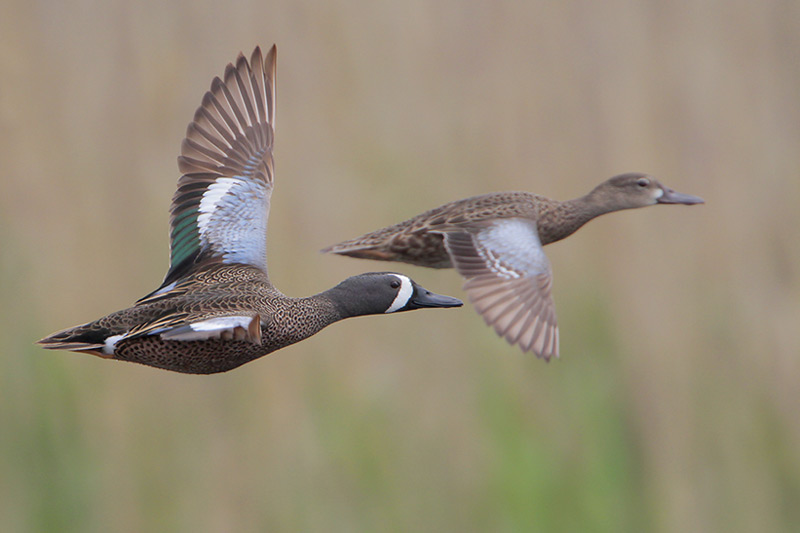
The Blue-winged Teal is a small dabbling duck and the second most abundant duck in North America. Breeding males have brown bodies with dense black speckles and a bluish-gray head with a bold white crescent in front of the eye. Females have a coarsely marked brown body with a darker cap and eye-line on the head. When in flight their wings show green secondaries and powdery-blue shoulder patches. Male calls are a high whistle or nasal bleat, while the females give evenly spaced quacks.
Blue-winged Teal typically nest in grasses or herbaceous vegetation and in the summer, they tend to forage in ponds or pond-marsh mixed habitats. During migration these ducks use marshes, wetlands, and shallow rice fields. They typically prefer to stop in freshwater or brackish areas rather than saltwater. Outside of the United States, these birds may use other related habitats, such as estuaries or mangroves in Central and South America.
Blue-winged Teal eat aquatic insects such as larvae, crustaceans, clams, and snails. These forms of protein are important for egg laying females. They also eat vegetation and grains such as seeds, which are the predominant foods in the winter. Blue-winged Teal feed by dabbling. They dip their bills in the water, submerging their entire head to reach prey or vegetation deeper underwater. Nests are made after a female has selected a nesting site, which may take several days, and are composed of dried grasses, down and breast feathers. A typical clutch size for these ducks can be anywhere from 6 to 14 eggs.
Blue-winged Teal are long distance migrants, and thus have an extensive range. They breed throughout the United States and Canada and migrate south to Central and South America for the winter. They winter as far south as Brazil and central Chile. Blue-winged Teal are permanent residents to the gulf coast of Texas and can be observed on calm bodies of water from marshes to small lakes in the area. A good place to look for them at this time of the year is Anahuac National Wildlife Refuge, where Shoveler Pond and the other bodies of water surrounding it is a common place they can be found.


Visit our Bird Gallery to read about other Texas birds!
 Houston AuduBlog
Brilliant shot!
LikeLike
I saw a pair this past week in a swamp two Saya in a row..I thoroughly enjoyed myself and gor some nice videos
LikeLike