
By Schyler Brown, Houston Audubon Conservation Specialist
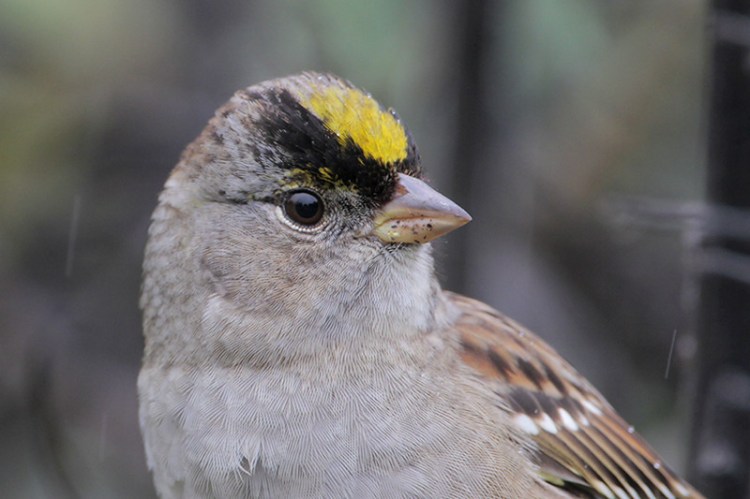
To better understand and protect our birds, we have to look at their movement through habitats across broad landscapes. Typically, scientists do this by counting birds and surveying plants where the birds occur, but this takes a lot of time and money, and usually only covers a small area of land. By using satellite imagery instead, researchers study previously unknown habits of the Golden-crowned Sparrow, which helps conservation biologists better understand how to protect this species. For example, biologists previously suspected that Golden-crowned Sparrows used habitats in their wintering grounds that were similar to their breeding grounds; however, thanks to satellite imagery, scientists now know that this sparrow’s migration is more complicated.
In the spring, migrating Golden-crowned Sparrows preferred warmer, low elevation habitats compared to fall migration. Furthermore, the scientists found that the sparrows preferred shrubland habitat in both seasons and open forests in the spring, suggesting that when birds need re-fueling during their spring migration and food is available in forests, the sparrows are less picky about what habitat they stop in. Finally, the researchers found that Golden-crowned Sparrows make longer migration flights in the fall than they do in the spring time. By understanding the life-cycle and habits of migrating birds, conservationists can better protect them and their habitat.

Iverson, A.R., Humple, D.L., Cormier, R.L. et al. Land cover and NDVI are important predictors in habitat selection along migration for the Golden-crowned Sparrow, a temperate-zone migrating songbird. Mov Ecol 11, 2 (2023). https://doi.org/10.1186/s40462-022-00353-2
 Houston AuduBlog