

Bobolink (Dolichonyx oryzivorous)
Family: Icteridae
By Grace Yaros, Houston Audubon Coastal Conservation Technician
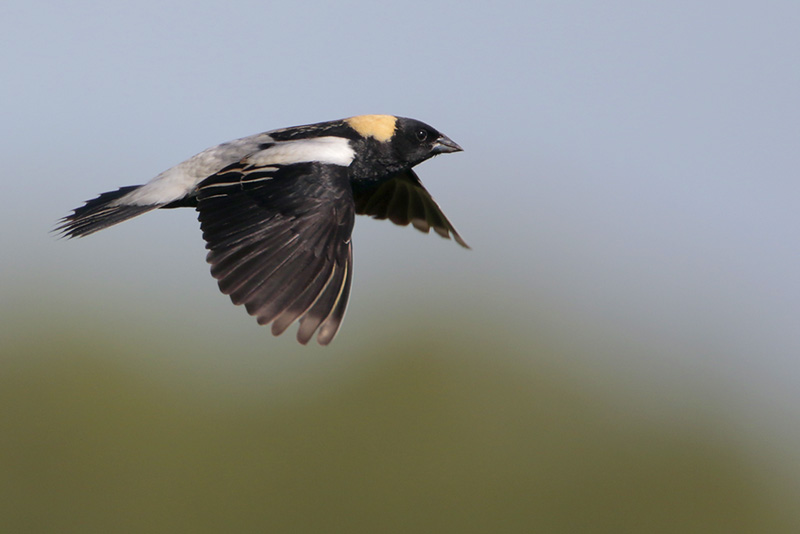
Bobolinks are handsome, fairly small blackbirds. Females are golden overall with blackish streaks on their backs, sides, and crown, including a line behind their eye. Breeding males are distinctive: they are black with mostly white backs and a golden nape. During the non-breeding season, males are similar in appearance to females.
During the spring and summer, Bobolinks can be found across much of the northern United States and southern Canada, from New England and the Mid-Atlantic westward to Montana and as far south as West Virginia. They breed in open grasslands, hay fields, and meadows. Males will sing their bubbly, somewhat mechanical song from a perch or as they fly low over their territories. Their nests are built on the ground, and males and females both mate with multiple partners. Outside of the breeding season, they are very social, gathering in large flocks. Bobolinks spend the winter in southern South America– mostly in Argentina, Bolivia, and Paraguay– and have one of the longest migrations of any North American songbird! During the spring, they may be found on the Bolivar Peninsula as they make their way north.
Bobolinks feed primarily on grains, and are considered pests in rice fields, where they may be shot or trapped. Their populations have declined in the past few decades, but collaboration with landowners to adopt practices such as grazing fields less intensively and mowing hay fields before and/or after peak nesting season will help ensure that future generations will be able to continue to marvel at these spectacular birds.

Visit our Bird Gallery to read about other Texas birds!
 Houston AuduBlog