
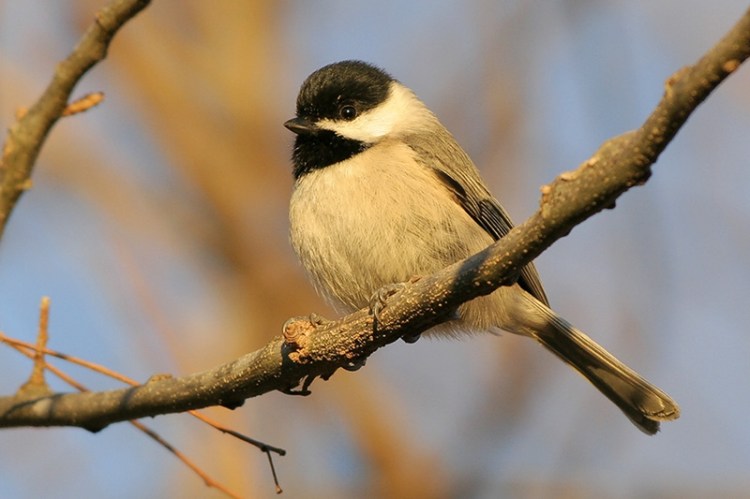
Carolina Chickadee (Poecile carolinensis)
Family: Paridae
By Grace Yaros, Houston Audubon Coastal Conservation Technician
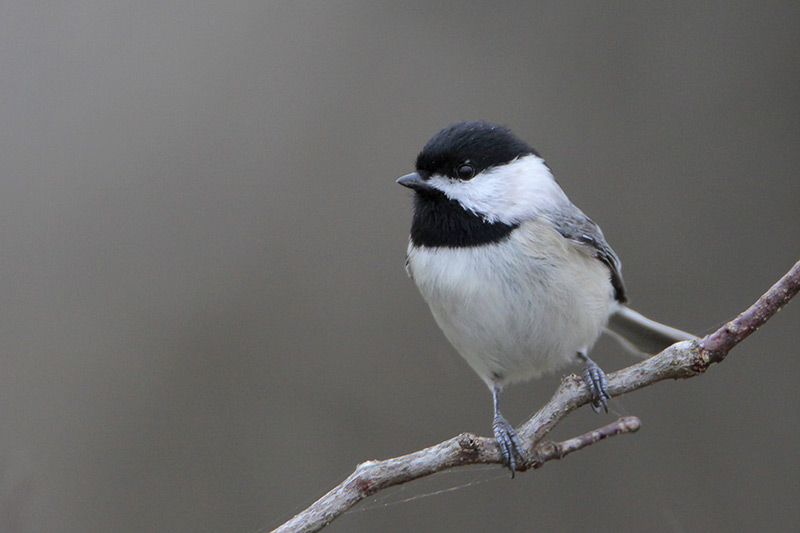
Carolina Chickadees are familiar birds across much of the southeastern United States, at home in urban and suburban environments and readily coming to birdfeeders. They have gray backs and wings and are whitish below with a pale orange wash on their sides. They have a black cap and throat with contrasting white cheeks. They are quite vocal, and their namesake “chick-a-dee” calls can alert you to the presence of a nearby flock. Males will also sing to defend breeding territories; their song is variable, and consists of 4-6 whistled notes.
They are found from New Jersey and Pennsylvania south through central Florida, with their range extending as far west as central Texas. They inhabit a variety of wooded habitats, from open suburban parks to deciduous or mixed deciduous-coniferous forests. They are generally absent from higher elevation areas throughout the Appalachian Mountains, and in the Appalachians and near the northernmost portions of their range, Carolina Chickadees are generally displaced by or hybridize with Black-capped Chickadees. Carolina Chickadees feed on a diversity of food items. For the majority of the year, they feed mostly on insects and spiders, but fruits and seeds are important additions to their diet, especially during the winter.
Outside of the breeding season, Carolina Chickadees associate in flocks, often with other songbirds such as Tufted Titmice, kinglets, and nuthatches. These flocks will defend their territory from neighboring chickadees. Within these flocks, the chickadees maintain a strict social hierarchy. When a flock disperses during the breeding season, the highest-ranking males and their mates will nest in breeding territories that overlap with the flock’s winter territory. They are cavity nesters, and will readily nest in pre-existing cavities, cavities that they excavate themselves, and in nest boxes. Lower-ranking males must travel further to secure a breeding territory, though some unpaired lower-ranking males may remain on a high-ranking pair’s breeding territory. Carolina Chickadees can be found throughout the Houston area, including Edith L. Moore Nature Sanctuary!

Visit our Bird Gallery to read about other Texas birds!
 Houston AuduBlog