
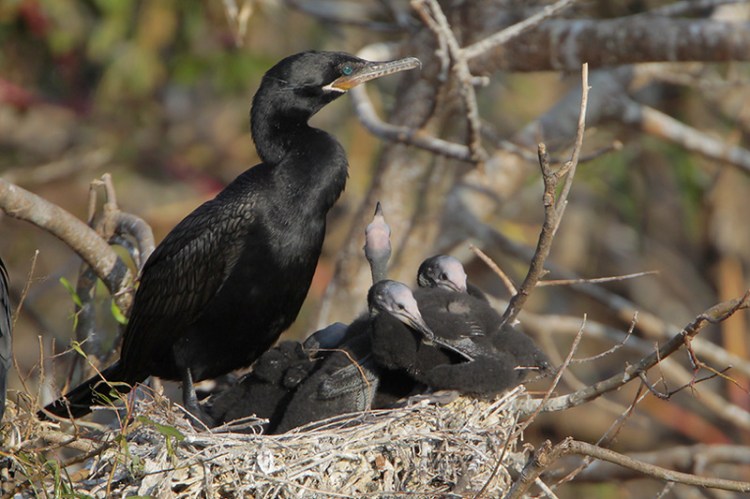
Neotropic Cormorant (Nannopterum brasilianum)
Family: Phalacrocoracidae
By Charlie Ayers, Houston Audubon Coastal Conservation Technician
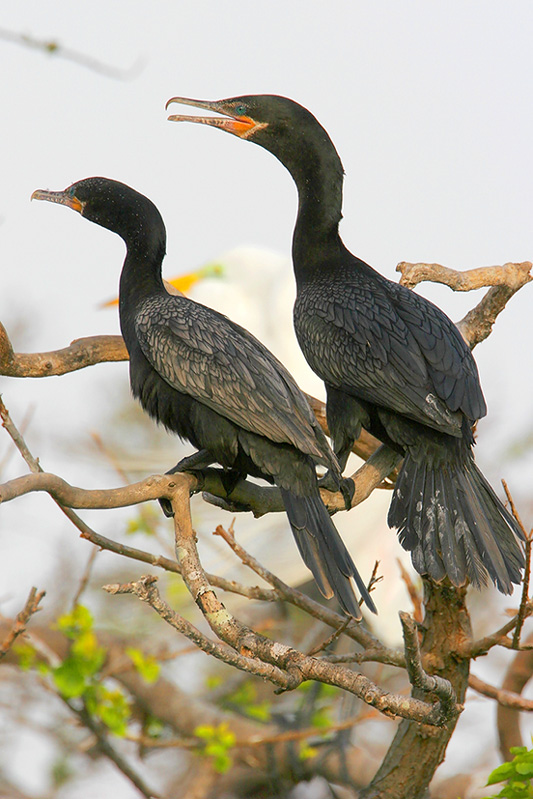
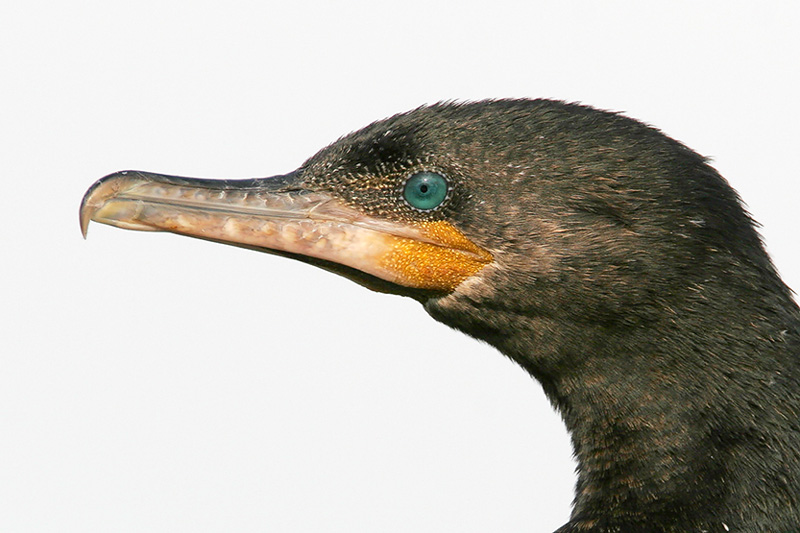
This week’s Beak of the Week is the Neotropic Cormorant. When birding near any body of water, be on the lookout for this small, slim, nearly all black bird with a long tail, large webbed feet and a thin straight bill with a hook on the end. However, this may not be enough to help you identify a Neotropic Cormorant. This is because, much to a birder’s dismay, there are two other species that look similar to the Neotropic Cormorant-the Double-crested Cormorant and the Anhinga. The first step to separating the three species is size. Neotropic Cormorants are about half the size of Double-crested Cormorants and Anhingas. An easy way to remember this is that Double-crested Cormorants are double the size of a Neotropic Cormorant. If you aren’t confident on size, the next step is to look at the face. Adult Neotropic Cormorants have a thin white line on their chin, white tufts sprouting from where their ears would be, and a yellow bare patch of skin only below the beak. If you happen to come across a juvenile of the two cormorants, look for a very pale, almost white chest and belly; this is an indicator that you are seeing a Double-crested Cormorant.
Neotropic Cormorants perform an odd behavior for a bird living above the equator; they breed twice a year, once in the summer and a second time in the fall. Neotropic Cormorants, like many of our wading birds, will nest in a rookery, which is a colonial waterbird’s nesting location. These sites often contain hundreds to thousands of birds, and Smith Oaks Bird Sanctuary is the home to one of these special locations. If you go sit on the benches by Smith Pond at the sanctuary, you can see around 150 Neotropic Cormorant nests, many already containing eggs. The best time to go is an hour and a half before sunset as all the wading birds return to roost on the rookery for the night. It’s a truly spectacular event to watch as 4,000 birds of 10 different species come in to roost all within the same two hours.
Neotropic Cormorants can be found through much of Central and South America, but they are much harder to see here in North America. Almost all of the birds found in the US live year-round in Texas with smaller populations found in neighboring states such as Louisiana, Arizona and New Mexico. Good places to see these birds are really anywhere with a good water source like Smith Oaks Bird Sanctuary, Bolivar Flats Bird Sanctuary and at the Shovelers Pond Loop at Anahuac National Wildlife Refuge.
Visit our Bird Gallery to read about other Texas birds!
 Houston AuduBlog