

Peregrine Falcon (Falco peregrinus)
Family: Falconidae
By Nick Minnich, Houston Audubon Coastal Conservation Technician
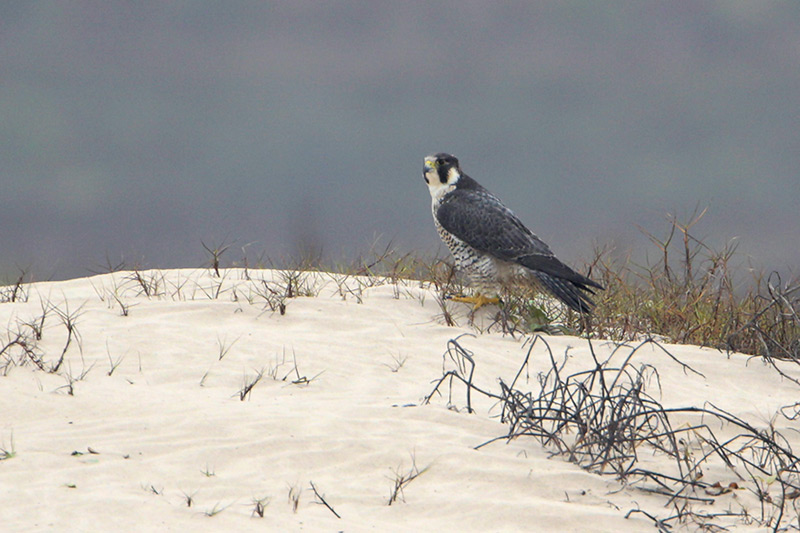
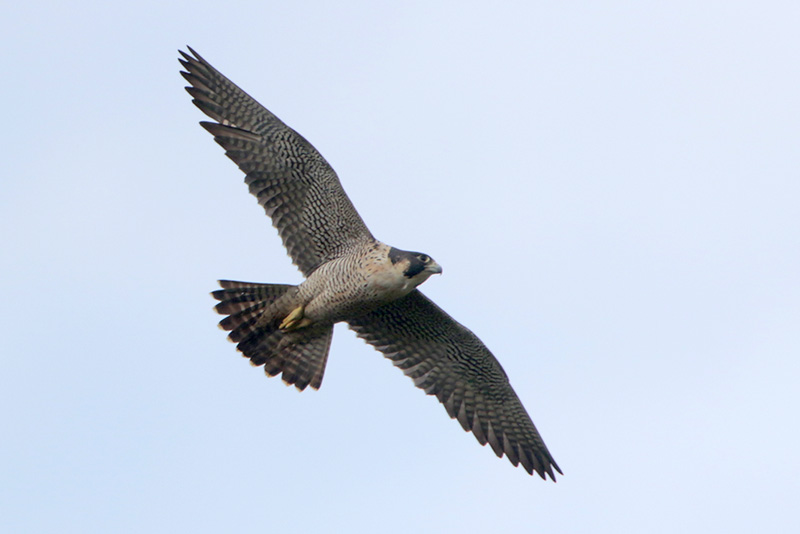
This week’s Beak of the Week is equipped with a unique adaptation that makes it the ultimate aerial hunter. Peregrine Falcons, regarded as the fastest flying bird, also have the widest natural distribution of any bird on Earth, nesting on every continent except Antarctica. Often clocking in at 200 mph, this falcon is one of the most spectacular birds of prey. The bird’s long and pointed wings, bluish-gray wash, black-barred underbelly, and black helmeted appearance make it absolutely unmistakable.
Peregrine Falcons are primarily avivores, typically favoring pigeons around cities while often taking ducks and shorebirds along the coast. This bird hunts by flying at high levels, and then stooping in a high-speed dive to strike larger prey midair. Additionally, prey can be taken by surprise at ground level. Peregrine Falcons possess a unique bill adaptation known as a tomial tooth, a mandibular projection which allows for more effective predation, moving much like a pair of scissors over the spinal cord of the prey.
Despite being a noble spectacle of the Falconidae, this bird faced widespread decline due to high concentration of pesticides during the mid to late 20th century. Nonetheless, the restriction of DDT coupled with recovery efforts by various conservation organizations have allowed the species to recover and eventually be delisted from the Endangered Species list in 1999.
While there are nearly twenty distinct subspecies of Peregrine Falcons in the world, the Anatum (American) and Tundra Peregrine are the dominant subspecies that occur in Texas. Tundra Peregrines are highly migratory, breeding on cliff ledges in the Arctic then traveling over much of North America to winter in South America. The Texas coastline plays an important role in the survival of these migrating birds, as the abundance of migrating shorebirds provides ample sustenance to fuel the journey.
The Bolivar Flats Shorebird Sanctuary is a great place to observe Peregrine Falcons foraging and exhibiting their unique hunting abilities. During a recent shorebird survey, the High Island team counted two individuals, including one banded on the Atlantic Coast. A great indicator that a Peregrine Falcon is in the vicinity is the sudden burst of shorebirds taking flight and flushing from their roost/forage locale.
Visit our Bird Gallery to read about other Texas birds!
 Houston AuduBlog