
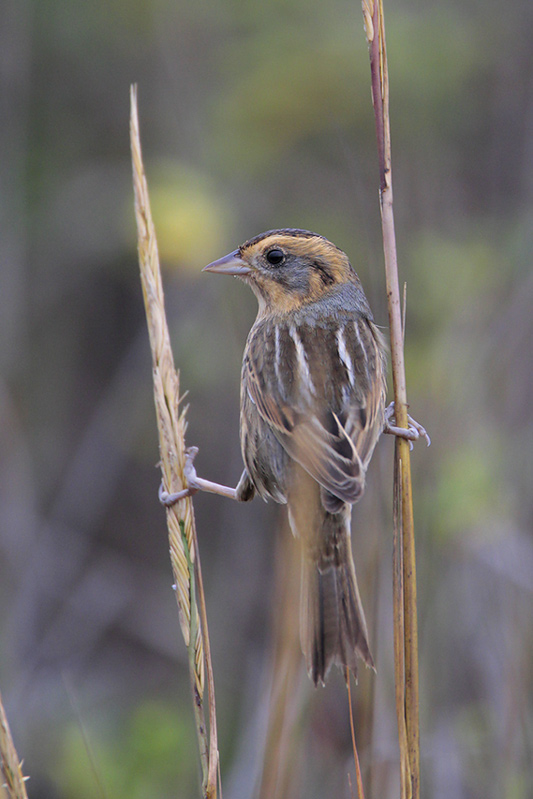
Nelson’s Sparrow (Ammospiza nelsoni)
Family: Passerellidae
By Charlie Ayers, Houston Audubon Coastal Conservation Technician
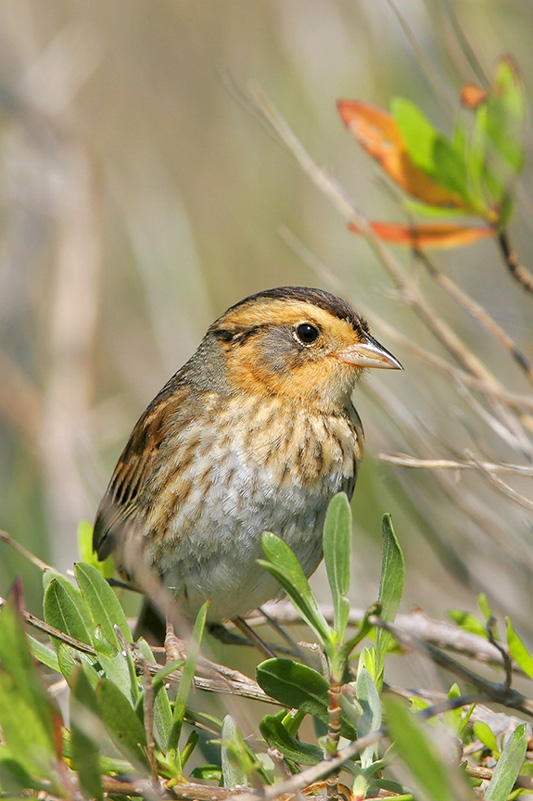
This week’s Beak of the Week brings pumpkin spice to the table, the Nelson’s Sparrow. The Nelson’s Sparrow is quite colorful for a member of this family. They can be identified by their bold yellow-orange faces, gray cheeks, and a neat band of yellow that runs across their lightly streaked bellies. These seldom seen sparrows are often hard to distinguish between their counterparts, the Saltmarsh Sparrow, so much so that up until 1998 they were lumped as one species known as the Sharp-tailed Sparrow. To differentiate between the two species, focus on the chests. Saltmarsh Sparrows will have heavier streaking and a much paler chest, lacking the orange wash of the Nelson’s Sparrow. Similarly, the face of the Saltmarsh Sparrow is much more sharply defined than that of the Nelson’s, with a brighter orange mustache that is contrasted by the pale chest and belly.
Nelson’s Sparrows spend all their time in marshes but where you find them will determine the type of marsh they use. Nelson’s Sparrows have a split range that generally does not intermingle. The Interior form, which can be found breeding in the freshwater marshes of the northern Great Plains, winters along the Gulf Coast from Texas to Florida, while the Atlantic form breeds along the Northern Atlantic Coast in saltwater marshes and overwinters along the southern Atlantic coast from Virginia to Florida. There’s talk of the Atlantic form becoming its own species. This split could be very important when it comes to their conservation. While overall the species is doing well, this Atlantic form is a much smaller population, possibly only about 25,000 individuals which almost exclusively nest in tidal marshes-an imperiled ecosystem in the Northeast. The splitting of this species could mean extra protection for the birds, which would not only improve their chances of survival but also many other threatened species that call these tidal marshes home.
Nelson’s Sparrows, like the majority of their family, spend most of their time on the ground foraging for insects. They will occasionally come up higher and perch on tall grass to eat the seeds at the top of grass stems-this is when it is easiest to spot them. You can find Nelson’s Sparrows at places like Bolivar Flats along the edges of the saltmarshes. During Houston Audubon’s most recent Bolivar Flats Beach Ramble, we spotted 14 individuals who popped out of the vegetation to forage and investigate what we were doing. Other places to check for Nelson’s Sparrows are Horseshoe Marsh Bird Sanctuary and the backside of Gast Red Bay Sanctuary where it opens up towards the marsh.

Visit our Bird Gallery to read about other Texas birds!
 Houston AuduBlog