
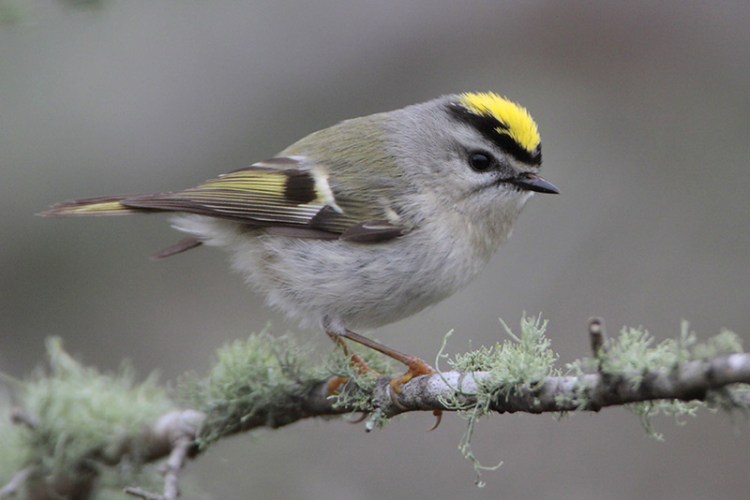
Golden-crowned Kinglet (Regulus satrapa)
Family: Regulidae
By Theresa Kelly, Houston Audubon Coastal Conservation Technician
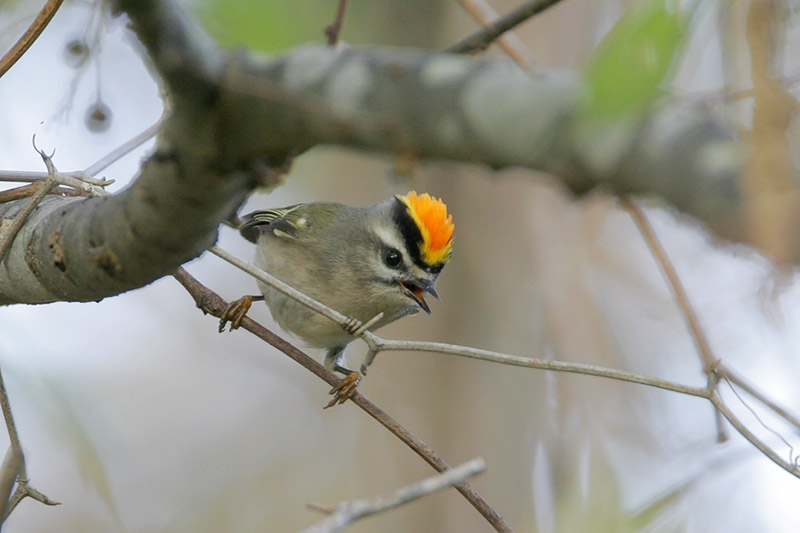
Despite its tiny size, this week’s Beak of the Week is astoundingly hardy, active, and agile. Golden-crowned Kinglets have a tiny, rounded body, short wings, and a skinny tail. Dull body coloration — pale olive and gray — is offset by distinct black striping in the face, yellow-edged flight feathers, and the bright golden crown for which they’re named. Although they resemble the Ruby-Crowned Kinglet in size and general body shape, they can be distinguished by the lack of a white eye-ring, presence of dark facial markings, and — if visible — the vivid color of their crown.
Avid insectivores, they have short, thin beaks which enable them to pluck small insects from clusters of conifer needles, oftentimes hovering in order to reach them. They can also pluck insects from under leaves…or even right from the air itself! You may have a hard time keeping a Golden-crowned Kinglet in your binoculars as they are hyperactive and fast-moving, often concealed in dense tree canopy. You might find it easier to listen for their high-pitched calls.
Golden-crowned Kinglets primarily live in coniferous forests. They breed in boreal or upland forests throughout Canada but spend their summers across a wide swath of North America. During non-breeding season, they tend to be much less selective about their habitat; although they still use conifers, they can also be found in suburbs, wetlands, and scrubby habitat, from sea level to elevations upwards of 10,000 feet. Tougher than they look, the Golden-crowned Kinglet can routinely survive nighttime temperatures below -40˚F in their northern breeding grounds. In spite of a short breeding season, they often lay two broods and will divide parental care. The female will care for the first brood until the day they leave the nest, after which they become the male’s responsibility while she lays and incubates the second brood.
Throughout Houston Audubon’s High Island sanctuaries, Golden-crowned Kinglets are common January residents. Sometimes difficult to spot in the higher branches where they nest, you may catch them foraging for food or nest materials in the lower canopy. When cold snaps hit, insectivores like kinglets and gnatcatchers will often hang out close to the ground, hopping through leaf litter for food. They may seem inquisitive, wandering close to your feet if you stand still for a moment, but they’re probably just hungry and best left undisturbed. If you are having a hard time spotting these active little passerines, you’ll certainly still hear their call — thin, accelerating tsee notes lasting several seconds, sometimes ending in a beautiful musical warble.

Visit our Bird Gallery to read about other Texas birds!
 Houston AuduBlog