
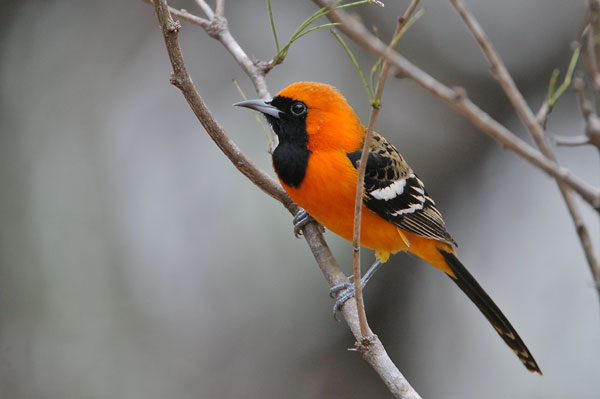
Hooded Oriole (Icterus cucullatus)
Family: Icteridae
By Charlie Ayers, Houston Audubon Coastal Conservation Technician
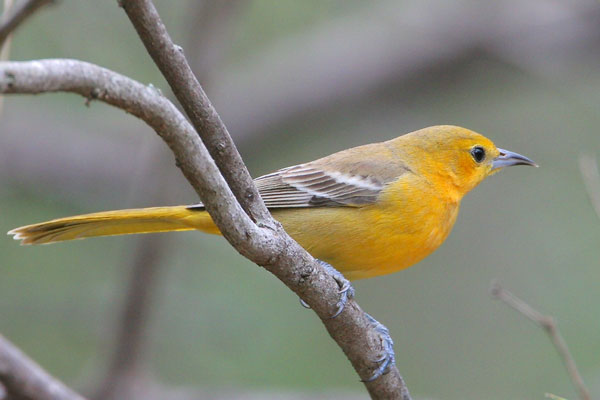
This week’s Beak of the Week is a flashy Icterid of south Texas, the Hooded Oriole. Hooded Orioles are slender birds with a flame orange body, black wings, a black tail and a black throat patch that extends up to their eye. Hooded Orioles can be difficult to identify from other orioles, but the combination of the features mentioned above would lead you to the correct ID. Altamira Orioles have a similar throat patch but lack the white wing bars. Baltimore Orioles have the white wing bars but have all black heads. The toughest ID challenge may be differentiating between a female Orchard and Hooded Oriole, as both have similar features when it comes to plumage. However, Hooded Orioles have long, slender, slightly curved bills while Orchard Orioles have short, straight bills. Hooded Orioles are also larger in size overall.
Hooded Orioles are acrobatic foragers, often hanging upside down while searching for food on the underside of large leaves such as palm fronds. They will forage for a variety of insects including caterpillars, grasshoppers and ants. Similar to other species of oriole, they will feed on fruit, flower nectar or directly from a hummingbird feeder. If you’re hoping to attract a vagrant Hooded Oriole, try and keep some orange slices out in the yard. You never know what might show up.
Hooded Oriole females build hanging nests made of grass materials that they sew together on the underside of a palm frond. This provides them with excellent protection from nest predation. You can find these beautiful orange birds more consistently in Rio Grande Valley during the spring and summer when they migrate north from Mexico to breed. However, this species has been found as far north as Montreal, Canada and Juneau, Alaska. Recently, one showed up in High Island near Boy Scout Woods. Interestingly, it was found feeding from Yellow Bellied Sapsucker wells. Keep an eye out as to where your neighborhood sapsuckers feed from, as it could be a great place to find rare birds getting some much needed calories during these cold days. You never know what you’ll find on any given day here at High Island, so come on down to our sanctuaries such as Boy Scout Woods, Smith Oaks or Gast Woods and see what you can find for yourself.

Visit our Bird Gallery to read about other Texas birds!
 Houston AuduBlog