

Prothonotary Warbler (Protonotaria citrea)
Family: Parulidae
By Theresa Kelly, Houston Audubon Coastal Conservation Technician
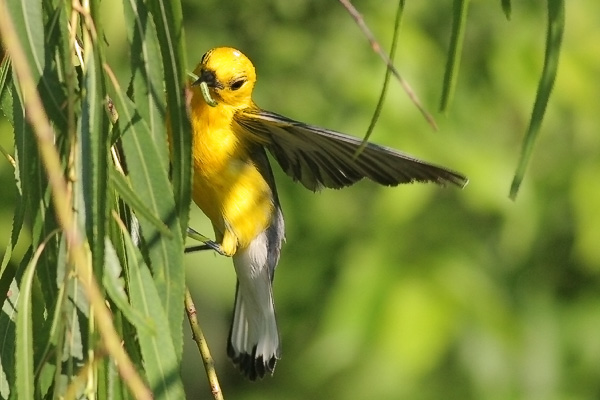
Like cardinals, this Beak of the Week claims the unusually specific honor of “birds named for Roman Catholic robes of office.” The Prothonotary Warbler’s astounding yellow hue is its most defining feature, leading early ornithologists to name it after the yellow robes that papal clerks (prothonotaries) wear. The bright, stoplight-yellow of its head, chest, and belly is offset by gray wings, a gray tail, and a bill the same shiny black as its eye. Like many warblers, their appearance differs by sex — females tend to be slightly paler overall, crown and nape washed in faint green, and their bills are stouter than the males. Several warbler species may look similar to the Prothonotary at first glance, but size can be your first identification clue. As a whole, Prothonotaries are large and heavy-bodied compared to other warblers, and they possess noticeably bigger bills as well. The bird most commonly mistaken with the Prothonotary is the Blue-winged Warbler, distinguishable by white wingbars, a black eyeline, and its smaller size. Yellow Warblers, also more petite than Prothonotaries, possess yellowish wings and males have chestnut streaking on the breast.
Unlike most warblers which nest on the ground, in shrubs, or in trees, Prothonotaries build nests in holes in standing dead trees. They breed in wet environments like flooded bottomlands, wooded swamps, and forests near lakes or streams. Although much of their range tends to hug coastlines and island chains, they may follow forested rivers inland and settle as far north as New York or Michigan during the breeding season. The nonbreeding season finds the Prothonotary Warbler in warmer climates: Mexico, Central America, and the northernmost part of South America. Avid insectivores, Prothonotary Warblers eat spiders, butterflies, moths, beetles, flies, and other creepy-crawlies. In addition to insects, they also eat snails, mollusks, and, during nonbreeding season, fruits and seeds. They forage in the understory, hopping along branches and on the ground in search of food, and may even climb trunks and pick at bark like a Black-and-White Warbler.
Partners in Flight rates this beautiful bird as “high conservation concern.” Because they are habitat specialists, they are particularly vulnerable to the destruction and alteration of forested wetlands. Local populations have responded well to the installation of nest boxes and restoration of natural flood regimes in their breeding grounds. While the effects of natural predation are minimal compared to that of habitat loss, Prothonotary Warblers do experience predation from snakes and raccoons, as well as brood parasitism by Brown-headed Cowbirds. Brood parasitism is when birds lay their eggs in the nests of other birds, forcing them to divert resources from their own young in order to raise the cowbirds. As a common US visitor in April, Prothonotary Warblers first start appearing in High Island around March. They are an easy spot thanks to their vivid coloring. You can find them foraging low in the canopy…and if you don’t see them, you’ll certainly hear their high-pitched, increasing series of tweet-tweet-tweet. Recently, a literal early bird was seen by Houston Audubon staff in Hooks Woods, likely the first February record for Galveston.

Visit our Bird Gallery to read about other Texas birds!
 Houston AuduBlog