

Ring-necked Duck (Aythya collaris)
Family: Anatidae
By Theresa Kelly, Houston Audubon Coastal Conservation Technician
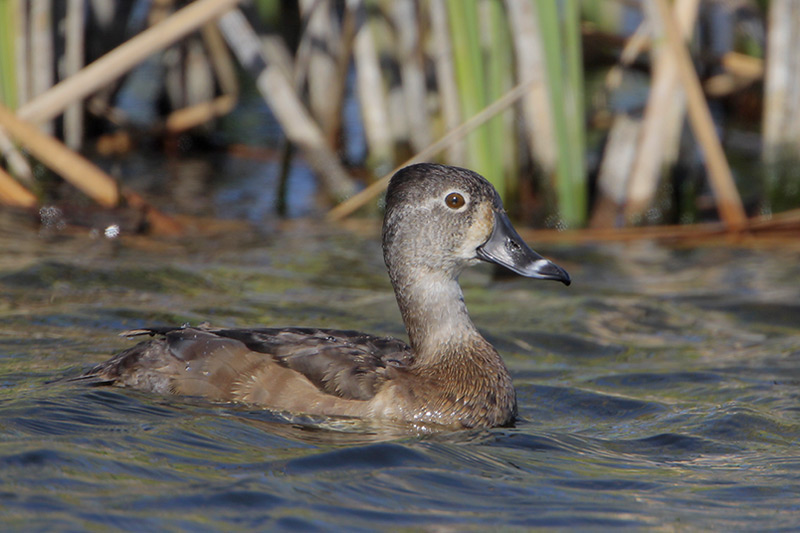
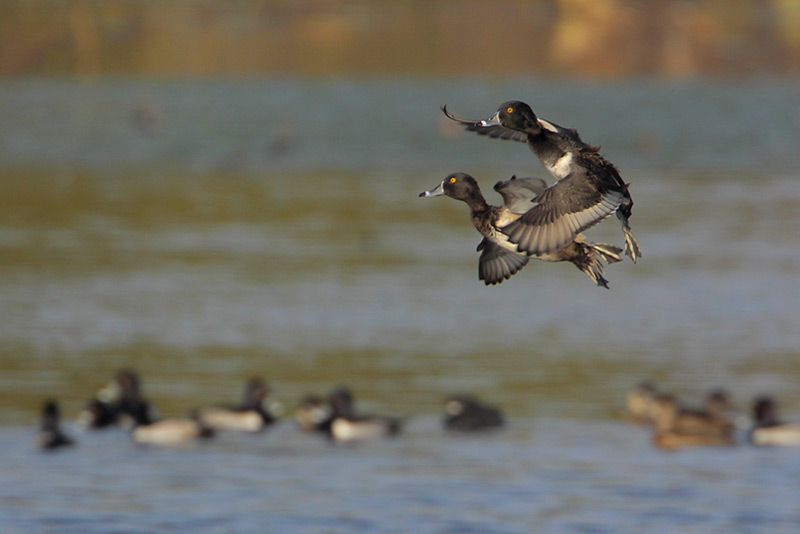
This week’s Beak of the Week, the Ring-necked Duck, earned both its common and scientific name (collaris) from the chestnut collar on its black neck. Decidedly difficult to make out in the field, they are better identified by other traits. The Ring-necked duck is a medium-sized diving duck with a peaked crown and strongly sloped forehead. Breeding males are black in the head, chest, and back, with pale gray sides, a white shoulder, and a glaring golden eye. Their bill is distinctly curved, with a bold white band separating the gray base from the black tip. Nonbreeding males are not as sharply colored, with dull brown sides and a fainter bill band, but they still possess the diagnostic peaked head and golden eye of breeding males. The red-brown body of female Ring-necked Ducks may resemble female Ruddy Ducks at first glance, though they possess the same hard-to-miss tricolored bill as the males. Females’ dark crown contrasts against their gray face, with a whiter patch near the bill that stands out even from a distance.
Ring-necked Ducks are often found in small flocks or pairs, sometimes intermingling with scaup or dabbling ducks. Despite being a diving duck, in winter and migration times they can be found on small, shallow bodies of water such as beaver ponds, small lakes, marshes, and even flooded agricultural fields. During fall migration, they sometimes form massive flocks, with several hundred thousand congregating on Minnesota lakes to feed on wild rice. Their nonbreeding range is expansive, covering nearly all of the southern US and Mexico, and they can also be found wintering in the Pacific Northwest, along the mid-Atlantic coast, and across large portions of Central America and the Caribbean Islands.
Usually omnivorous, Ring-necked Ducks eat aquatic vegetation (including stems, seeds, and tubers) as well as mollusks, snails, dragonfly nymphs, leeches, and earthworms. Interestingly, their diet can shift from season to season: animal food becomes a much bigger part of the diet for females during breeding season because it’s much higher in protein, while plant foods are more important during fall migration.
Houston Audubon staff recently found several Ring-necked Ducks feeding in a small pond just off of High Island beach. Though they are deemed rare, they can still be found in the Houston area through most of April. Over the coming weeks, keep an eye on freshwater marshes and retention ponds, because you never know what you might see popping up for air!
Visit our Bird Gallery to read about other Texas birds!
 Houston AuduBlog