

Dark-eyed Junco (Junco hyemalis)
Family: Passerellidae
By Theresa Kelly, Houston Audubon Coastal Conservation Technician
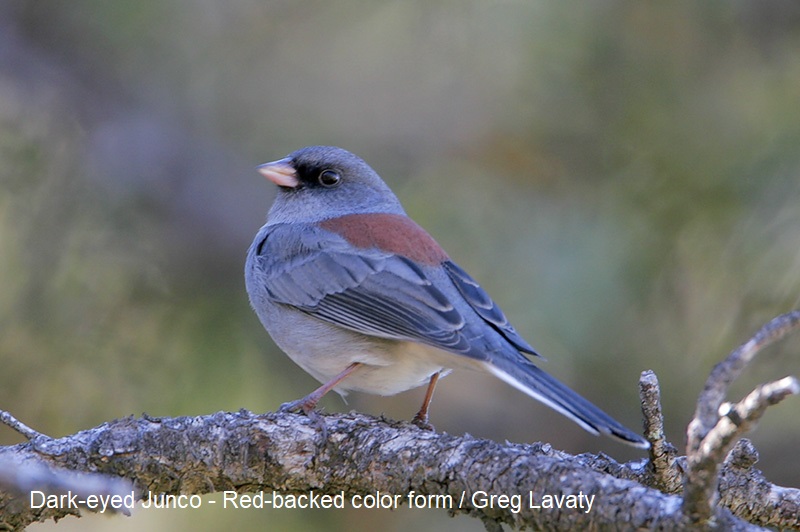
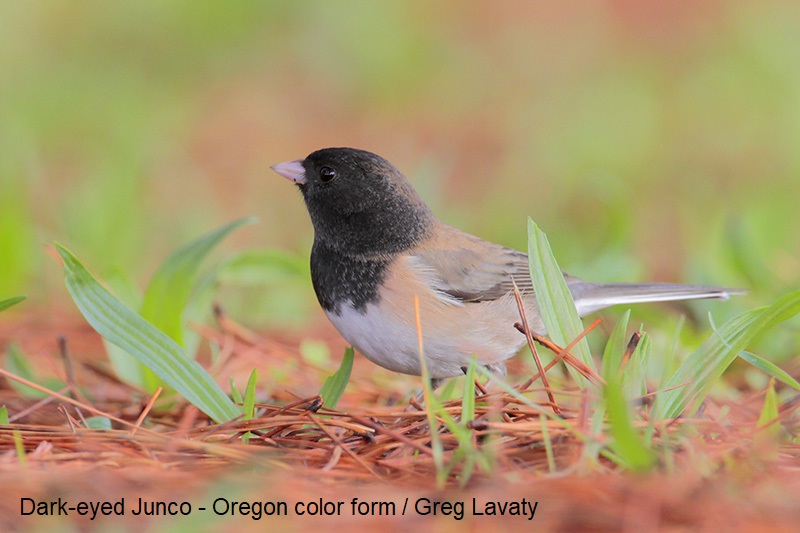
This Beak of the Week has a very expansive range and an incredible array of plumages. The Dark-eyed Junco is a medium-sized sparrow, possessing the short, conical bill and rotund body shape common to its family. Their coloring varies greatly by region, but Dark-eyed Juncos as a species are one of the most common birds in North America. They’re found from east to west, ranging as far north as Alaska during breeding season and as far south as Mexico during wintertime. The most widespread Junco color forms are Slate-colored (common to the eastern US & most of Canada) and Oregon (found across much of the western US). Slate-colored males, as the name suggests, are dark gray with a white belly, while females and juveniles tend to be more brown. Oregon juncos have a dark hood, brown back, and brown sides, and they show relatively little dimorphism between sexes. Several regions of North America have their own forms, including — but not limited to — the Red-backed of the Southwestern US (gray overall, with a black mask and red back patch), the Rocky Mountains’ Pink-sided (gray head, brown back, and buffy-pink sides), and the White-winged form of middle-America (gray overall, with faint white wingbars and a dark face). Highly differing plumage can often cause an IDing headache, but all color forms have the same round head, pale bill, and conspicuously long tail with white outer feathers.
Dark-eyed Juncos are often found on the ground, hopping around shrubs and trees or foraging in open areas like a natural clearing or a lawn. Juncos forage in large flocks, occasionally intermingling with other sparrows or bluebirds. In regions of range overlap, you may find several subspecies in a single flock. While foraging, juncos’ flights are often short and low in the underbrush, sometimes flying up from the ground to catch insects on tree trunks. As they do so, you may catch the bright flash of their distinguishing white tail feathers. Interestingly, Dark-eyed Juncos are hierarchical; earlier arrivals to a foraging site are higher in the pecking order.
Typically ground nesters, Juncos may occasionally build nests on horizontal branches, window ledges, or hanging flower pots. Females choose the nest site, often in a depression in the ground, on a rock face, or among the roots of an upturned tree. Nest construction varies based on location — they can be a simple lining of pine needles or they can be made up of several layers of twigs, leaves, moss, hair, and grass. The majority of their diet is seeds, but during breeding season they will also eat insects for the high protein content.
Although Dark-eyed Juncos are a rare find for March and April, you may still find one of these energetic little sparrows inhabiting our forested High Island sanctuaries. Keep an eye on the ground for them as they forage, and keep an ear out for their loud, repetitive musical trill.
Visit our Bird Gallery to read about other Texas birds!
 Houston AuduBlog