
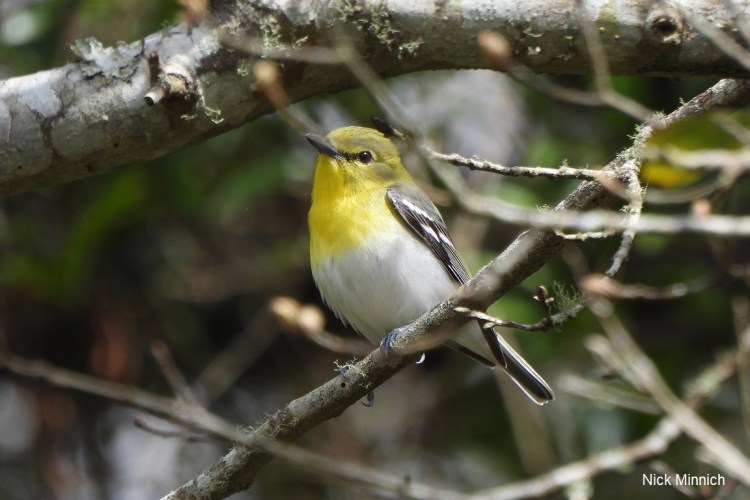
Yellow-throated Vireo (Vireo flavifrons)
Family: Vireonidae
By Nick Minnich, Houston Audubon Coastal Conservation Technician
The Yellow-throated Vireo is one of the most striking North American vireos, with its bright yellow throat and breast plumage, broad yellow spectacles around the eyes, and gray wings with two bold white wingbars. Often, this bird frequents forest-edge habitat and tends to roam high up in the canopy. Deciduous or mixed-deciduous forests are its primary habitat, with infrequent activity in stands of conifers. During migration, this bird may also occur in shrubby areas along barrier beaches. Yellow-throated Vireos are best described as foliage gleaners, hopping between branches and often focusing on the interior parts of the canopy. While other vireos typically forage in a frenzied manner, this bird forages for insects on bare branches, carefully selecting prey. Its beak is thick and slightly hooked, allowing this species to maintain an omnivorous diet, consuming both fruits and seeds, as well as insects and spiders.
Yellow-throated Vireos have an extensive breeding ground, spanning from southeastern Manitoba and Ontario all the way south the the Gulf Coast near sea level, preferring tall, deciduous riparian trees. Their nest is typically suspended from a fork of a narrow tree branch around 30-60 feet from ground level. While many North American songbirds leave the females to incubate and brood, Yellow-throated Vireos share this responsibility. On the breeding grounds, Yellow-throated Vireos may sound like Red-eyed Vireos, but with a burrier song. Newly arriving male Yellow-throated Vireos will select multiple potential nest locations within their territory while displaying within this territory. He will also conduct much of the initial nest-building, with the female taking over to complete the structure after accepting his nest site and courtship. The finishing touches of the bark-strip, dry grass, and plant fibered nest will often be decorated with lichens and moss.
During the early 20th century, this vireo encountered widespread decline due to pesticide spraying for Dutch Elm and other tree diseases. With increased awareness and control of these chemicals, the species’ population has since rebounded. Along with the other closely-related vireo species, Yellow-throated Vireos face threats including habitat loss and fragmentation on both breeding grounds and wintering grounds in the Caribbean, Central and South America. Collisions with glass and communication towers are also a threat to these species, especially during migration.
Yellow-throated Vireos are an early spring arrival in High Island, with the first reported individual of the 2025 season arriving at Hooks Woods Sanctuary on March 9 following a cold front (along with a Northern Parula, Yellow-throated Warbler, and Broad-winged Hawk). Spring is certainly underway in High Island. We are so excited for you to visit our sanctuaries and hopefully get eyes, binoculars, and cameras on this passerine and so many other fun spring migrants.


Visit our Bird Gallery to read about other Texas birds!
 Houston AuduBlog
tremendous! Scientists Successfully Clone Endangered Species 2025 precious
LikeLike