

By Patti Goodman, Property Manager, MetroNational
I love birds. I’m fairly obsessed with them, as my family, friends, co-workers, and anyone I’ve talked to for more than a few minutes can attest to. Several years ago, I had just become aware that there is an array of beautiful birds living in and moving through our area when I joined the property management team at Memorial City Plaza, a campus of three high-rise office buildings set on three acres within Memorial City, a city-within-the-city developed and owned by MetroNational.
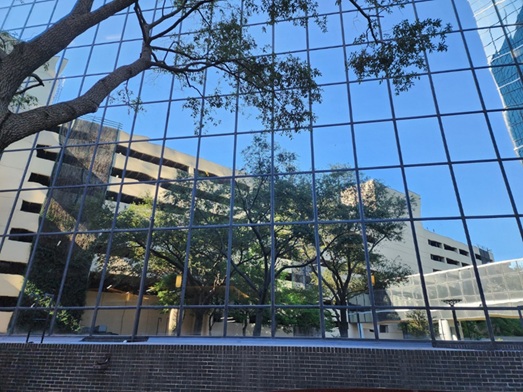
As I walked the campus that first autumn, I found a few birds around the buildings’ perimeters. Some were stunned (I took them to a rehab center) and some were dead. As I researched this phenomenon, I learned that this was the result of birds striking windows – one of the most devastating hazards birds face during spring and fall migration. I learned that window strikes take place not just during the day, but also at night. Most bird species migrate at night, and bright lights from buildings and homes disorient them, drawing them towards the lights. Birds don’t perceive the glass and strike the window through which light emanates. Window strikes during the day are caused when a bird encounters a reflective window and believes it to be sky or trees, or it does not perceive a clear window.
Once I understood the problem, I set out to find a solution. I contacted Houston Audubon for help. A member of the Houston Audubon team and I surveyed the campus. We identified bird strike hot spots and formulated an immediate action plan as well as a program to be rolled out over the next several years.
The immediate action was to turn off program exterior lights (such as landscaping and soffit lights) from 11 PM to 6 AM during migration season. Lobbies are on reduced lighting during these hours, and our janitorial crew turns off office lights when they leave at 10 PM. MetroNational’s 12 Memorial City office buildings signed the Lights Out for Birds pledge to turn off nonessential lights during migration season.
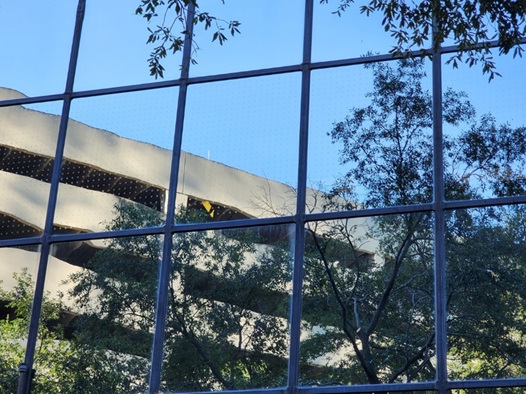
Next was the long-term plan. Houston Audubon introduced me to CollidEscape, a company that sells anti-bird-strike window dot systems. The window treatment was installed on the management office row of windows, which was also a bird-strike hot spot. Our management team agreed to act as test subjects to determine the effect of the dots on outdoor views. Window dot installation at other hot spots is slated over the next several years.
I am happy to report that these measures have dramatically reduced the number of window strikes. As we near the end of the first spring migration since we instituted the Lights Out for Birds program, I have found only one injured bird in the area that used to be our main location of collisions caused by nighttime lighting.
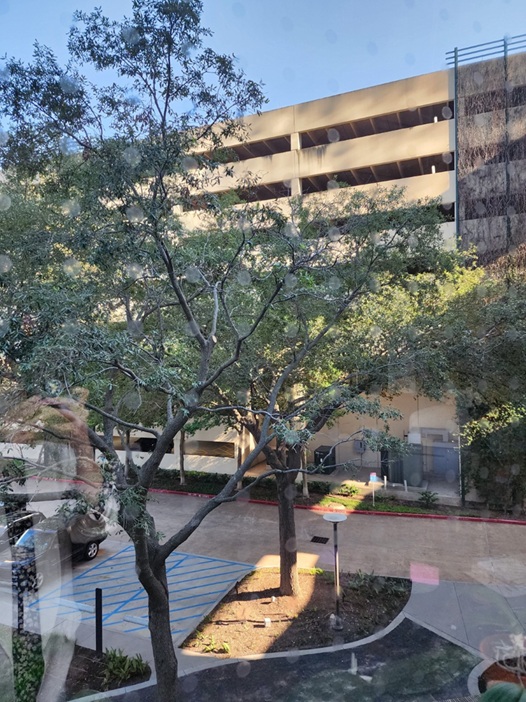
We have not had any collisions with the management office windows, and our management team members report minimal effect on outdoor views. In January, I witnessed proof of success as a Cedar Waxwing flew out of the live oak tree behind my office and suddenly turned back about one foot from the window.
My management team is responsible for the safety and well-being of several thousands of people on the property on any given weekday. I believe we all have a responsibility to protect, to the best of our ability, the natural world around us, including the incredible birds that bless us with their presence year-round and those that migrate through our city to reach their breeding and wintering grounds in other parts of the world.
 Houston AuduBlog