

Wyatt Egelhoff, Sanctuary Manager, Houston Audubon
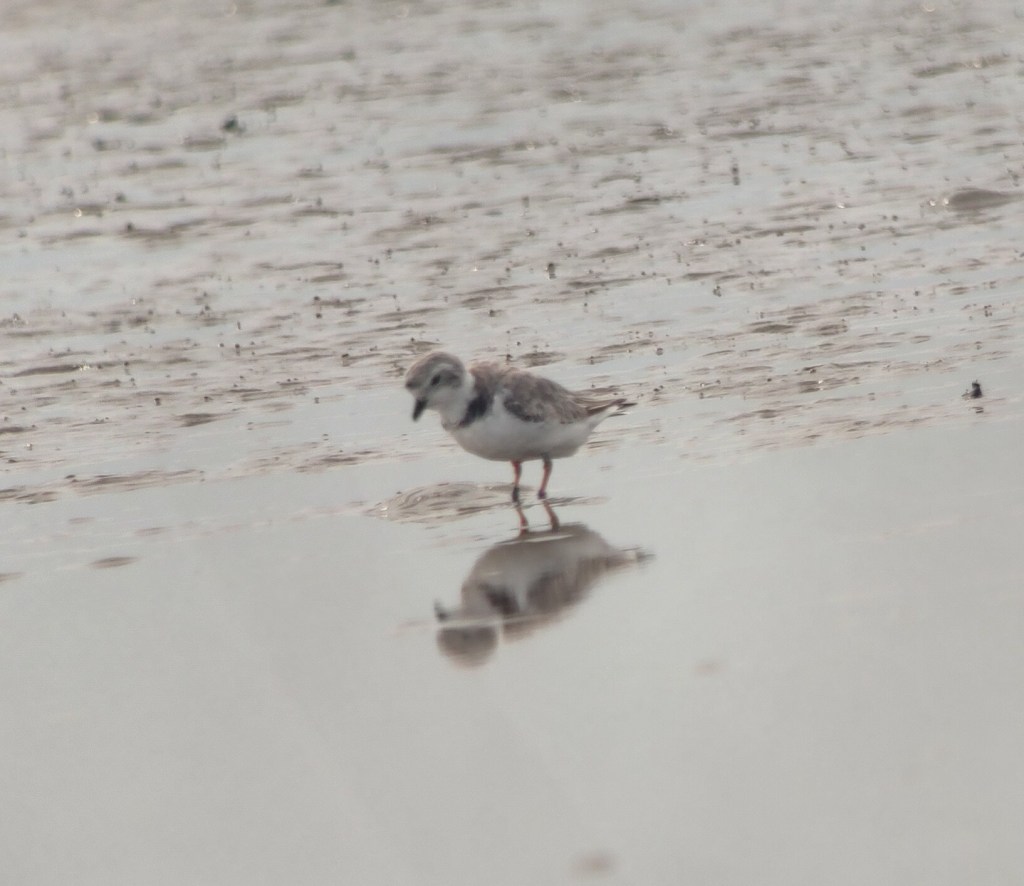
We’re excited to introduce everyone to a “new” Piping Plover at Bolivar Flats – “VGV” (short for ”Violet, Dark Green, Violet”)! This female Piping Plover was born in the Apostle Islands National Lakeshore (Lake Superior), Wisconsin in 2023. She returned to the area in 2024 and this past summer to breed near the mouth of the Bad River. Houston Audubon staff discovered her at Bolivar Flats last week while conducting regular Audubon Coastal Bird Surveys. She is identifiable by an orange flag on the upper right leg and aforementioned combination of violet and dark green bands. The orange flag is a quick way to separate this as a “Great Lakes” bird, of which there are only approximately 80 pairs nesting in any given year. This is the first time VGV has been detected away from her breeding sites.
Visitors to Bolivar Flats Shorebird Sanctuary may notice many Piping Plovers bearing either Yellow or Turquoise colored leg flags. These correspond to birds the breed in North Dakota and Nebraska, respectively. The vast majority of the banded Piping Plovers that use the Galveston Bay area (and presumably those that are un-banded) belong to this Great Plains breeding population. This is the most robust of the three breeding populations for this threatened species. However, sometimes we get surprises. VGV is the third Great Lakes Piping Plover to be detected at Bolivar Flats in recent years. Some may remember “Monty,” the male half of the famous pair that nested at Montrose Park in Chicago. He was a regular sight at East Beach on Galveston Island and at Bolivar Flats for many winters until his passing in 2022. We are anxiously awaiting the return of our other known Great Lakes Plover, male “YVL.” He was born on North Manitou Island, Michigan in 2022 and continues to return to that site to breed.
The discovery of these and other uniquely marked shorebirds at Bolivar Flats Shorebird Sanctuary provides exciting and tangible evidence of this site’s interconnectedness to places throughout the Western Hemisphere and sometimes beyond. It takes more than a village to protect these birds. It requires a network of researchers, stewards, volunteers, and land managers to study and protect highly migratory bird species across their annual cycles. Bolivar Flats is just one very large and important piece of a large and complicated puzzle.
What to do if you see a banded bird: Take a photo and send it to info@houstonaudubon so we can report it. Alternatively, you can submit the report yourself at bandedbirds.org.
 Houston AuduBlog