

Reddish Egret (Egretta rufescens)
Family: Ardeidae
By Colleen McDonough, Houston Audubon Coastal Conservation Technician
The Reddish Egret is North America’s rarest (and likely most eccentric) heron. An array of fast-paced and erratic hunting movements makes these birds stand out boldly among other wading species. Reddish Egrets are found almost exclusively near saltwater and brackish wetlands, in estuaries and marshy areas along the Gulf Coast, the Florida Atlantic Coast, Mexico and the Caribbean. Reddish Egrets have two morphs, a common red-and-blue colored dark morph and a rarer white morph. A dark morph Reddish Egret is most easily mistaken for a Little Blue Heron, but note that Little Blues’ necks are more purplish in color versus the Reddish’s rusty color, as well as the significant size difference between the two. The white morph could be mistaken for a Great Egret, but the Reddish Egret’s bill is bicolored in adulthood and black while immature. Reddish Egrets are typically silent, but may make deep, guttural calls when in distress.
As colonial nesters, Reddish Egrets will form rookeries with other wading bird species during the breeding season. The world’s largest nesting colony of Reddish Egrets is found on Green Island, located near South Padre Island and managed by Audubon Texas. Covered in thorny plants, teeming with insects, and far from the mainland, Green Island was a stronghold for the species while their populations declined sharply from plume hunting. Texas egrets actually prefer spiky vegetation, like prickly pear cacti, for nest building. Reddish Egrets have both resident and migratory populations, with some Texas birds travelling southward towards Mexico in the wintertime. Adults are also known to wander regionally along coastlines based on prey availability.
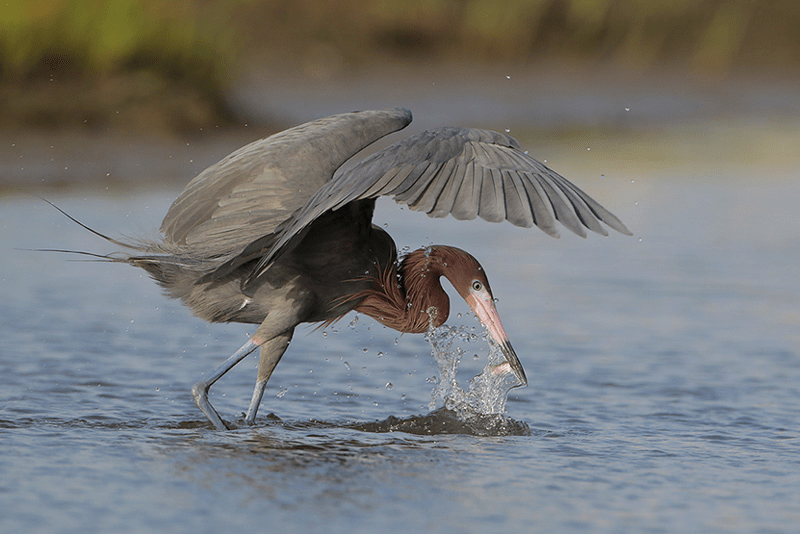
A shockingly acrobatic heron, the Reddish Egret puts on an amazing show while hunting; splaying its wings and running, spinning, and jumping in the surf. These birds are often found hunting alone or in small groups, and stick to shallow waters to catch minnows and small crustaceans. They will sometimes canopy feed, creating a shade over the water’s surface with their wings that reduces glare and attracts fish. Similar to Snowy Egrets, Reddish Egrets are also known to wiggle their feet through sediment to flush their prey out of hiding.
Similar to other heron species, Reddish Egrets were hunted to near extinction for their plumes in the 19th and early 20th centuries. Today, rising sea levels are shrinking the coastal islands that Reddish Egrets depend on for breeding. The species is listed as Threatened in Texas with only a few thousand breeding pairs remaining in the United States. Reddish Egrets are locally common year-round at Bolivar Flats, usually hunting solo in shallow depths or in tidal pools at the end of the shoreline.

Visit our Bird Gallery to read about other Texas birds!
 Houston AuduBlog