
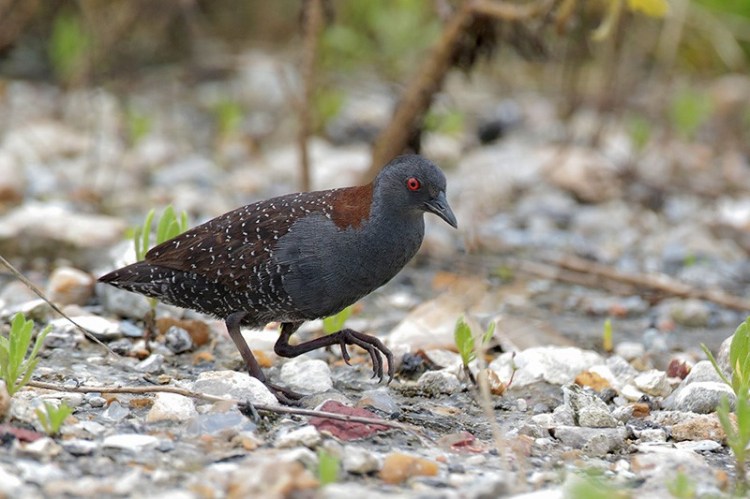
Black Rail (Laterallus jamaicensis)
Family: Rallidae
By Robert Buckert, Houston Audubon Coastal Conservation Technician
This week’s beak is held by the smallest rail in North America. Similar in size to a sparrow, the Black Rail is one of the most highly sought-after and difficult species to spot, proving infamously elusive as it buries itself in the shadows of dense marsh grasses. These rails typically use the shallowest water of all rails (only about an inch deep!), which reduces competition within the family, but puts the birds at greater threat of water level disruption (due to climate change or marsh draining) and terrestrial predators. They use their short black bills to hunt for a wide range of invertebrates, including spiders, snails, grasshoppers, earwigs, beetles, and ants. They also occasionally consume seeds of aquatic vegetation. Being small birds themselves, they are eaten by herons, egrets, and raptors of the marsh, as well as mammals and snakes.
Before breeding, males will occupy and defend territories up to 10 acres in size! To maximize your chances of detecting one, head out to the marsh at dusk or pre-dawn and listen carefully for their distinct and charismatic ‘kic kic-kerrr’ song. Here in Texas, Black Rails strongly prefer bunchgrasses in the coastal prairies and marshes, chiefly Gulf Cordgrass (Spartina spartinae) and Salt Meadow Cordgrass (Spartina patens) for you grass nerds. Both parents are active in the breeding process, building nests woven of rushes, sedges, and grasses. They are constructed on or near the ground typically at the base of taller vegetation. The rails lay 4-13 eggs in a clutch and will rear 1-2 broods. They incubate these 1-inch long eggs for 17-20 days before the precocial young depart the nest on the day of hatching, with their age of independence unknown. Due to their secretive and inaccessible nature, many of the finer details of their life history are still unknown.
This species has an extensively disjunct range. Black Rails are found breeding in south central Kansas, southern New Jersey, the Delmarva Peninsula and coastal Virginia. They are found year-round farther south down the Atlantic coast, across central Florida and along the Florida Gulf Coast. They are also found year-round in the central Texas Gulf coast, four distinct locations in California, and on Hispaniola. They winter on the upper Texas coast into Louisiana, in South Florida, and in Cuba, Jamaica, and Puerto Rico. Lastly, there is a year-round population on the coast of northern Chile. Phew! Did you catch all that? Looking at a map will be the best way to take it in… With such distinct populations making use of highly specialized habitats across their range, conservation is extremely challenging.
There is an estimated global breeding population of 52,000 Black Rails. The species is listed as a Red Alert Tipping Point species on the 2025 State of the Birds report, meaning they have lost >50% of their population over the past 50 years. They are listed as Threatened or Endangered in eight states as wetlands across the country have become developed, drained, flooded, or separated. These incredibly dapper and special rails call our very own Bolivar Flats Sanctuary home, and provide another spectacular feather in the cap of why we must continue to protect it. If you are lucky enough to catch a glimpse or revel in its song, you are sure to cherish it forever.
Help us protect Bolivar Flats from impending development for the Black Rail and hundreds of other species that rely on this critical habitat.

Visit our Bird Gallery to read about other Texas birds!
 Houston AuduBlog