

Gadwall (Mareca strepera)
Family: Anatidae

By Spencer Poling, Houston Audubon Coastal Conservation Technician
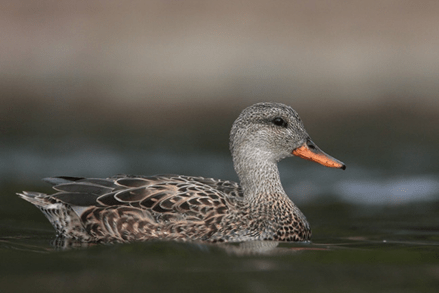
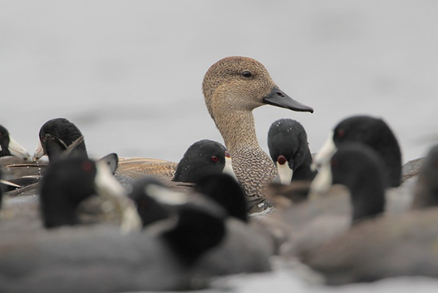
Easy to overlook from a distance as a plain gray bird, Gadwalls become increasingly more beautiful and fascinating the closer you look. Males are especially striking up close, with intricately patterned gray and silver breasts, a white wing patch called a speculum, and a black rump. They belong to a genus of dabbling duck, which means they feed by tipping headfirst into the water while pointing their tails straight up, which showcases their black rump for an easy ID! Females, like many duck species, need a closer look and a bit of studying to identify. They can be distinguished by the small amount of black on the bill and the continuous orange edging along its sides. Female Mallards appear similar but have much more black on their bills, while Mottled Ducks have entirely yellow bills. You may also see the white speculum patch that appears in females and makes for a visible ID in flight.
Gadwalls, as with other dabbling ducks, feed on the plants and animals that they can find beneath them in shallow waters. They are primarily herbivorous, especially during the wintertime when they are found along the Upper Texas Coast. While feeding, you may even catch them stealing food from other dabbling ducks or American Coots. This is a form of parasitism called kleptoparasitism and can be seen by other bird species like American Wigeons, Parasitic Jaegers, and Bald Eagles.
Though Gadwalls have gained a reputation for their parasitic behavior, they themselves are also a victim of another form of parasitism, called brood parasitism. Yes, it’s a crazy world out there, even parasites have parasites! Brood parasitism, where the female of one species lays its eggs in the nest of another bird, is actually quite common in the world of ducks, with at least 21 species reported to exhibit this behavior. Common brood parasites of Gadwalls are Redheads, Ruddy Ducks, and Lesser Scaup. If you thought the web of parasitism was already tangled enough, there’s more to it—Gadwalls also are brood parasites and lay their eggs in the nests of other Gadwalls!
Thanks to conservation efforts like habitat protection and regulated hunting, Gadwalls remain common and a species of Least Concern in the ICUN Red List. Regardless of Gadwalls being one of the most hunted ducks in the United States, with roughly a quarter of their population hunted each year, their populations are still growing annually! Besides being a common species in the United States, Gadwalls are also an Old-World species that ranges across much of Europe, Africa, and Asia. There may be a chance that you’ll find this interesting, familiar species when traveling.
One special place to spot Gadwalls is at Houston Audubon’s Horseshoe Marsh Bird Sanctuary, which spans 650 acres across the Bolivar Peninsula.
Explore Houston Audubon’s sanctuaries: https://houstonaudubon.org/conservation/sanctuaries/
Visit our Bird Gallery to read about other Texas birds!
 Houston AuduBlog