
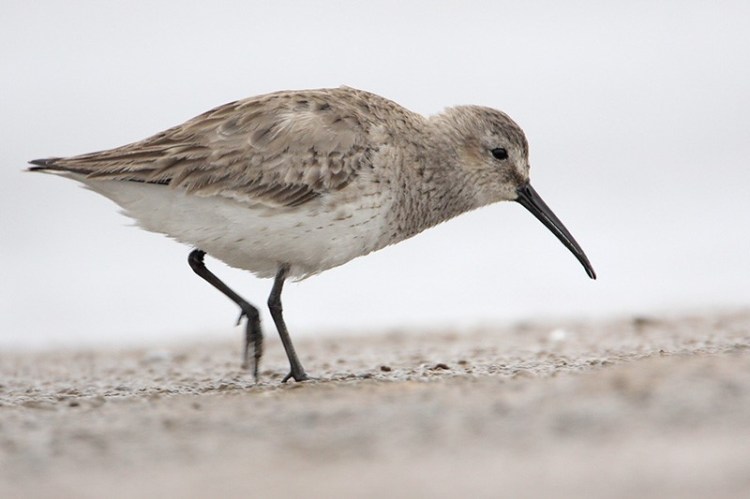
Dunlin (Calidris alpina)
Family: Scolopacidae

By Robert Buckert, Houston Audubon Coastal Conservation Technician
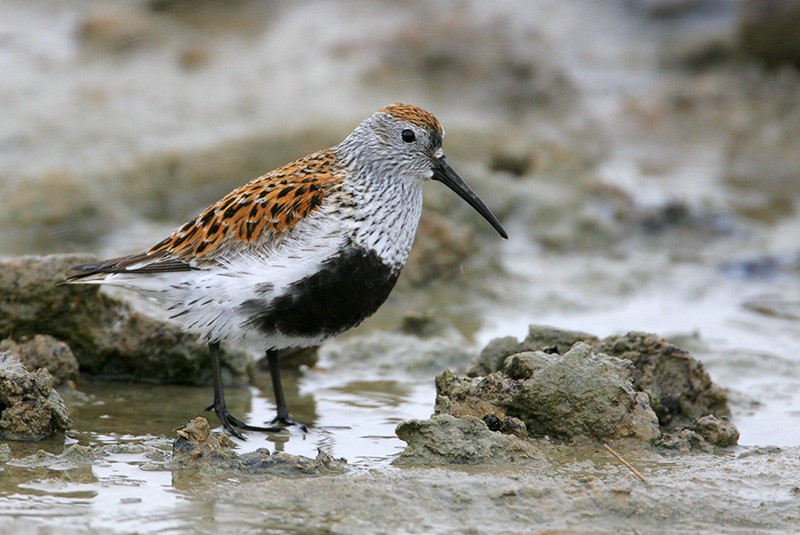
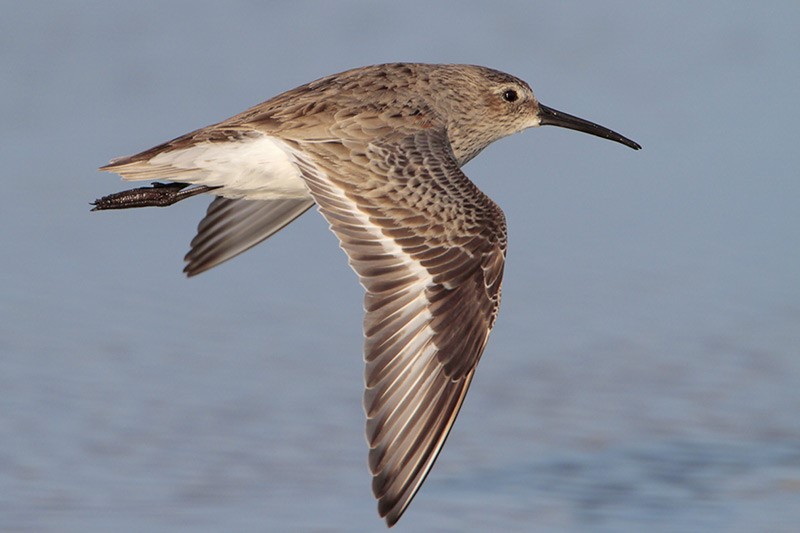
| While the Dunlin often blends into the crowd on mudflats, this small shorebird should not be overlooked. Its unique common name is derived from an old English moniker, dunling: “dun” meaning dull brown and “-ling” being a thing with a certain quality, so its name means “dull brown thing.” This is a fair description of its nonbreeding plumage, but it is a crime against its breeding finery. Lucky for us, the Dunlin can be found in coastal habitats across the continental US throughout most of the year. The Dunlin belongs to the genus Calidris, comprising two dozen species of sandpipers found around the globe. In the birding world, the smallest and most similar-looking species of this genus are categorized as “peeps,” posing steep identification challenges to many. The Dunlin presents itself as an excellent benchmark species to become familiar with as a beginner. Dunlins are not considered peeps, as they are in the next size class above the smallest sandpipers. So, in being able to identify a Dunlin with confidence, you have an excellent indicator of relative size (as well as behavior) across the flocks. In the breeding season, their rufous upperparts and black belly make it difficult to confuse this species with any other. In the nonbreeding season, however, they are plain, dullish brown above and white below, like many other shorebirds. Note particularly their long, downcurved bill, black legs, and relative chunkiness. In flight, they display white wing stripes. It is also useful to learn their scratchy “kree” call. Watch as they use their longer bills to probe into the substrate in a sewing-machine fashion, locating invertebrates tactilely. A side-note on countershading: Ever notice how a large proportion of shorebirds, including the Dunlin, display the same color scheme of dark above and light below? This plumage pattern, referred to as countershading (or obliterative coloration), is no accident. Predator-prey dynamics prove to be one of the strongest selective forces of evolution, and thus countershading is a common form of camouflage with several mechanisms. As shorebirds are frequently hunted by aerial predators (falcons), their upperparts often help them blend in with the surrounding substrate (sand or mud) when viewed from above. The pale underside helps them blend in with the pale sky or water when viewed from below. The most interesting effect is shadow cancellation. Sunlight from above creates a shadow on a bird’s belly, making it easily visible. When the belly is pale and illuminated, it matches the tone of the upper surface, giving a flat, 2D appearance to the bird. Studies confirm that countershaded prey have much lower predation rates compared to non-countershaded prey. You are most likely to find Dunlins on mudflats across the Upper Texas Coast from late fall through spring, so now is a great time to go searching! You are also likely to find Dunlins in freshwater wetlands such as flooded farm fields, alongside dowitchers, yellowlegs, Killdeer, and snipe. They are a gregarious species, forming large feeding flocks alongside other shorebirds. As far as local sandpipers go, compare them with the much paler Sanderling and the much smaller Western and Least Sandpipers. Always consider the rare possibility of locating the closely-related European species, the Curlew Sandpiper! Dunlins have a circumpolar range, breeding in the tundra across the arctic zone, with each population heading to wintering zones across North America, Europe, Africa, and Asia. Though shorebirds are some of the most incredible long-distance migrants, here in North America, most Dunlin populations are relatively short-distance migrants, favoring our shorelines for winter. Thus, they are also later-season migrants in the fall, with Northern states experiencing movement through November and December. After departing our shorelines, males arrive just as the snow melts on the tundra, claiming 0.5–18 acre territories with song and flights. Males make several ground nests (scrapes) a few inches across and the female selects the final site. They are monogamous, incubating and raising young together. Three to four 1-inch eggs are laid and active, downy young hatch after 20–22 days. After just one month, they will depart back southwards. Being a widely distributed species, their global population is large at approximately 5.5 million, with 1.5 million in North America. Dunlins are therefore considered a “Least Concern” species in the IUCN rating, though we know little about their population trends. Some populations are experiencing steep declines. This includes a decline of >30% in the northern Alaska breeding population, one of the three in North America. The cause is unknown but may be related to winter habitat loss. Climate change threatens all arctic-breeding species. According to Audubon’s Survival By Degrees project, global warming of two degrees Celsius results in a 50% loss of their current North American breeding range, and three degrees Celsius could result in a 75% loss. |
Visit our Bird Gallery to read about other Texas birds!
 Houston AuduBlog