
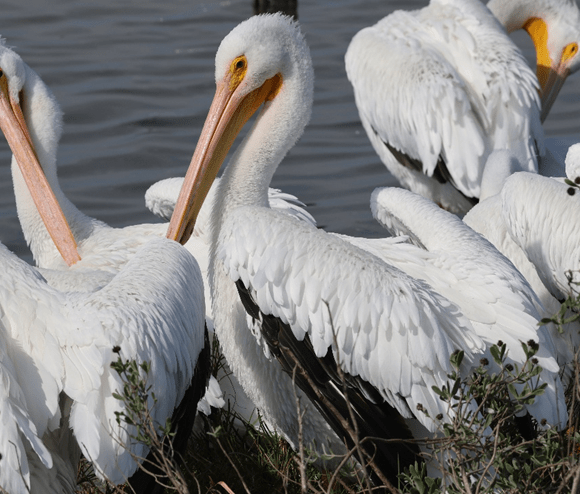
American White Pelican (Pelecanus erythrorhynchos)
Family: Pelecanidae

By Colleen McDonough, Houston Audubon Coastal Conservation Technician
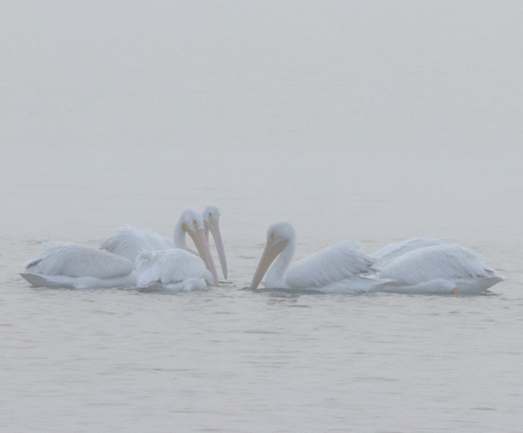
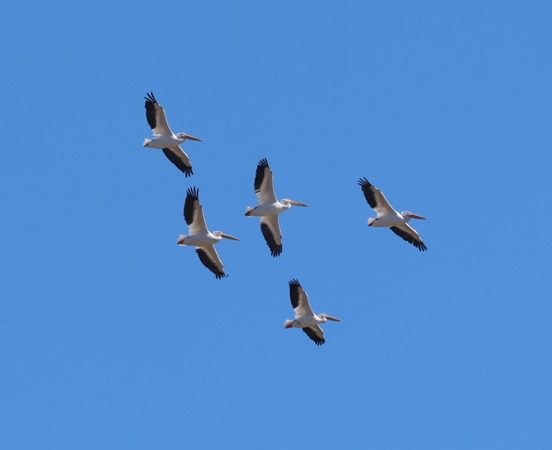
| Often seen soaring along coastlines in the wintertime, the American White Pelican has the largest wingspan of any Texas bird. Their hefty, white-feathered bodies, thick orange legs, and long bills set them apart from Brown Pelicans — another common pelican species on the Gulf Coast. During breeding season, males grow a raised plate or “horn” from their bill. Their black wing tips, which are visible in flight, can cause them to be mistaken for Snow Geese — another large waterbird species commonly seen flying in V-shaped flocks during winter. However, note the differing head size and shape. The pelican’s flight style is also characterized by a few powerful wingbeats followed by smooth gliding. While a few hundred pairs of non-migratory American White Pelicans are known to nest on islands along the southern Texas coast, most of the species’ population breeds inland near freshwater in the northern plains of the United States and Canada. These northern breeders migrate south for the winter, spending the season along the coasts of the southern United States and Mexico. American White Pelicans are colony nesters, digging depressions on sandy ground to lay two eggs in. Their young are altricial, meaning they are entirely dependent on their parents for warmth and protection in the first few weeks of life. It takes one to two weeks for chicks to learn to walk on their own, compared to the few hours after hatching for many other shorebird species! The American White Pelican chicks are known to exhibit siblicide, where two chicks may hatch, but only the stronger chick survives to the fledgling stage. Adult American White Pelicans feed their young by regurgitating meals into their throat pouch and offering it to them to eat. Their diet primarily consists of fish, along with crawfish and amphibians in freshwater areas. Unlike Brown Pelicans, they don’t plunge-dive, but rather swim in shallow areas and grab prey from the surface, expelling water through their throat pouch. American White Pelicans typically forage in groups, encircling and corralling fish. They are also known to swoop in and steal food caught by other birds, like cormorants and Osprey. Although American White Pelicans were not affected by DDT (a potent insecticide infamous for its devastating impact on wildlife) as severely as Brown Pelicans, they still suffered a decline in the 20th century, primarily due to changing water levels and habitat loss. Despite this, their population has since rebounded and is steadily growing. Throughout the winter and spring, American White Pelicans can be found at Bolivar Flats Shorebird Sanctuary, resting and preening on the mudflats or gliding along the beach. |
Visit our Bird Gallery to read about other Texas birds!
 Houston AuduBlog