
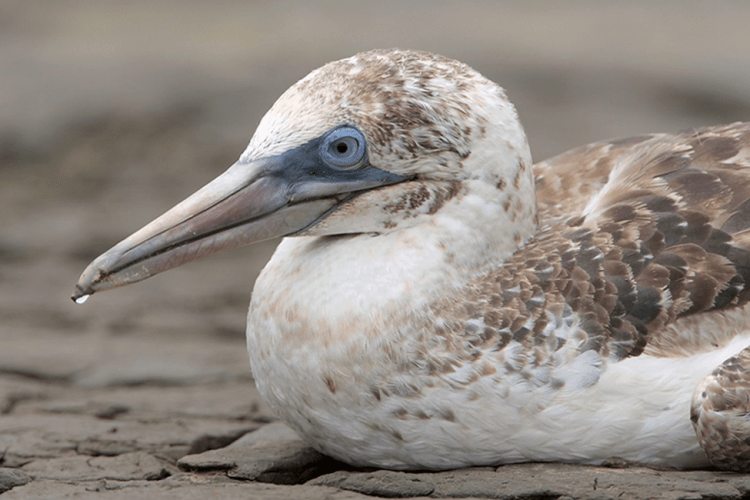
Northern Gannet (Morus bassanus)
Family: Sulidae

By Robert Buckert, Houston Audubon Coastal Conservation Technician
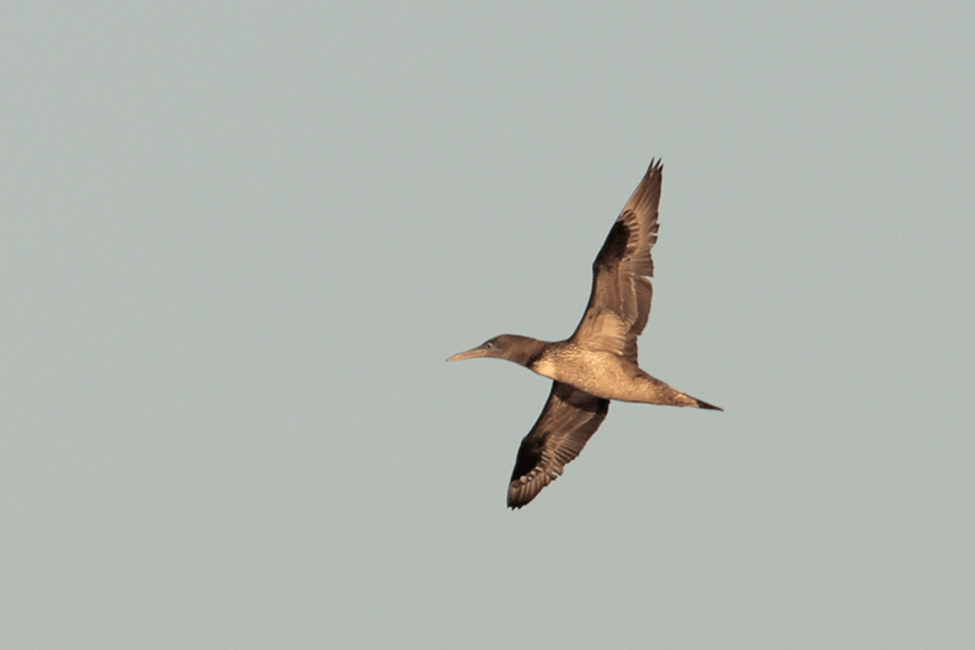
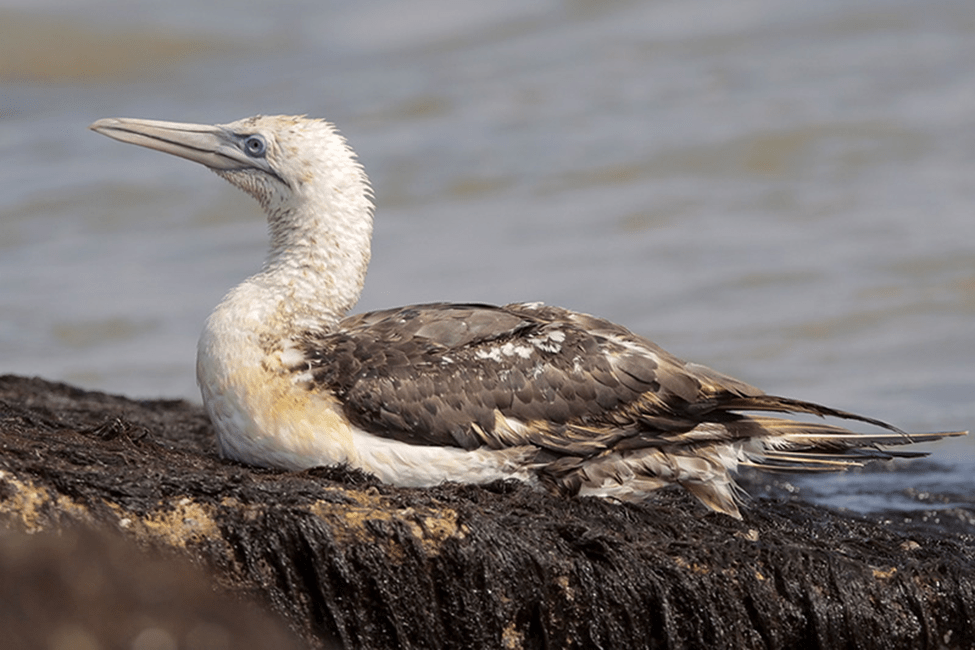
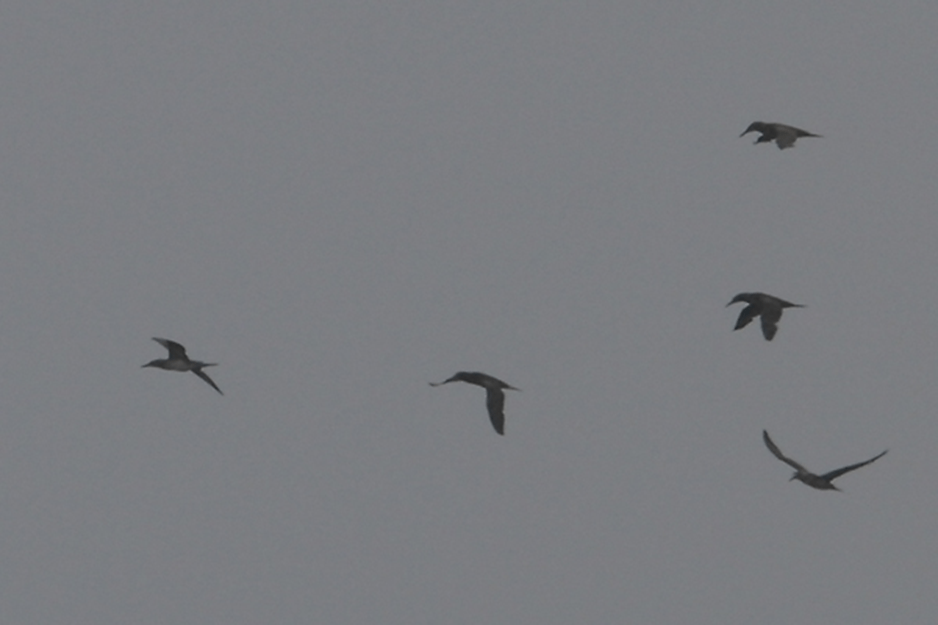
| As the temperatures continue to climb and the days grow longer, we all see spring just on the horizon. But let us not forget to turn and appreciate the wintering species of birds one last time, before the trees are dripping with warblers. One such species is the Northern Gannet (Morus bassanus), found in Texas waters from late fall through early spring. The Northern Gannet is a large seabird hailing from the North Atlantic that seldom comes ashore. Weighing nearly seven pounds and with a 5.5-6 feet wingspan, they are the largest member of the Sulidae family (boobies and gannets). The name gannet is derived from the Old English ‘ganot’ meaning ‘strong or masculine.’ You may be familiar with the Northern Gannet due to its prominent role in several oceanic nature documentaries. Gannets are renowned for their spectacular feeding behavior: they pile into pelagic feeding frenzies, sometimes numbering in the thousands, crashing down into the water at great speed in pursuit of fish. Gannets fly to heights of up to 130 feet, tuck their wings, and plunge headfirst into the water, reaching speeds of up to 60 miles per hour! They may swim to 70 feet deep or more before rising to the surface, using their sharp bill to capture muscular fish such as herring and mackerel. They can see immediately upon entry into the water and can even close their nostrils. As they are mostly white, this performance is often dubbed as a blizzard. The Northern Gannet is a well-studied species due to its proximity to Europe during the breeding season and holds much cultural significance there. Their vulnerable nesting colonies have long been used for food by inhabitants of Scandinavia and the United Kingdom, and they even earned a mention in Homer’s Odyssey. Gannets are known to nest in six colonies off the Canadian coast and 32 across Europe. They assemble in great numbers on small, rocky islands, preferring to nest on cliff faces with little to no predation danger, and facing a headwind for ease of takeoff. Males engage in intense territoriality and lengthy, costly fights for their patch of bare rock on the limited cliffsides. Pairs are monogamous for life, engaging in extensive, rather beautiful courtship interactions each time they reunite. Males do most of the nest building, using plant material, earth, feathers, and the occasional odd object found at sea, reinforced by excrement as the season draws on. Some nests grow to over several feet tall after many years. They raise only one chick, incubating for 42-46 days and feeding the nestling for 82-99 days. Mates take turns on fishing excursions, which may cover hundreds of miles. Following this lengthy breeding process, gannets fan out southward, often accumulating on the Atlantic coasts of Africa and the United States. Many gannets venture into the Gulf and are therefore a common pelagic species of Texas. They reward dedicated seawatchers with distant glimpses of groups in pursuit of fishing trawler bycatch or diving on schools of prey alongside Brown Pelicans. A majority of gannets that make it this far south are young birds. Juveniles are brownish overall with fine white spotting and a white patch at the tail base. Over the next four to five years, they undergo a cycle of partially brown and white plumages, similar to the cycle undergone by Bald Eagles and many gulls. Adults are white with black wingtips and a yellowish color on the head. Regardless of age, gannets are very svelte and streamlined, with long, pointed wings, a long, pointed tail, and long, pointed head (catching a theme here?) and these features can help to eliminate many other species in identification. When viewed at a great distance, these birds can be distinguished from pelicans by their shallower wing flaps and slimmer bodies and wings (though the lack of a pelican bill may be difficult to discern at extreme offshore distances). To distinguish them from gulls, note their greater size and bulk, their tendency to glide, and their more rapid, shallow wing beats, contrasted with the deeper flaps and more buoyant flight of gulls. You will notice how swiftly they move through the air relative to other species, in full command of the oceanic wind. And of course, watch for their distinctive diving behavior. On February 24th, I was lucky enough to cross paths with at least 70 gannets feeding distantly and cruising by the High Island beach. Northern Gannets are listed as a species of Least Concern by the IUCN with a global population of over 700,000 (150,000 in North America). Harvesting at the nesting colonies occurs in very small numbers currently and DDT is no longer ravaging colonies by way of eggshell-thinning through bioaccumulation. However, they are not immune to current marine contaminants, fishing nets, overfishing (reducing prey availability), or plastic pollution impacting most seabirds. Notably, climate change is likely to alter the distribution of their prey species. Gannets rely on the proximity of their prey to their nesting locations, and alternate locations may not be available where future prey may be found. |
Visit our Bird Gallery to read about other Texas birds!
 Houston AuduBlog