
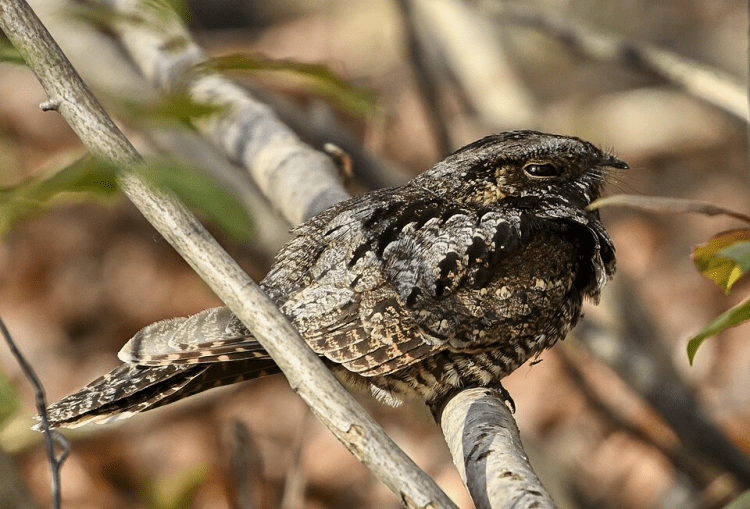
Eastern Whip-poor-will (Antrostomus vociferus)
Family: Caprimulgidae

By Robert Buckert, Houston Audubon Coastal Conservation Technician
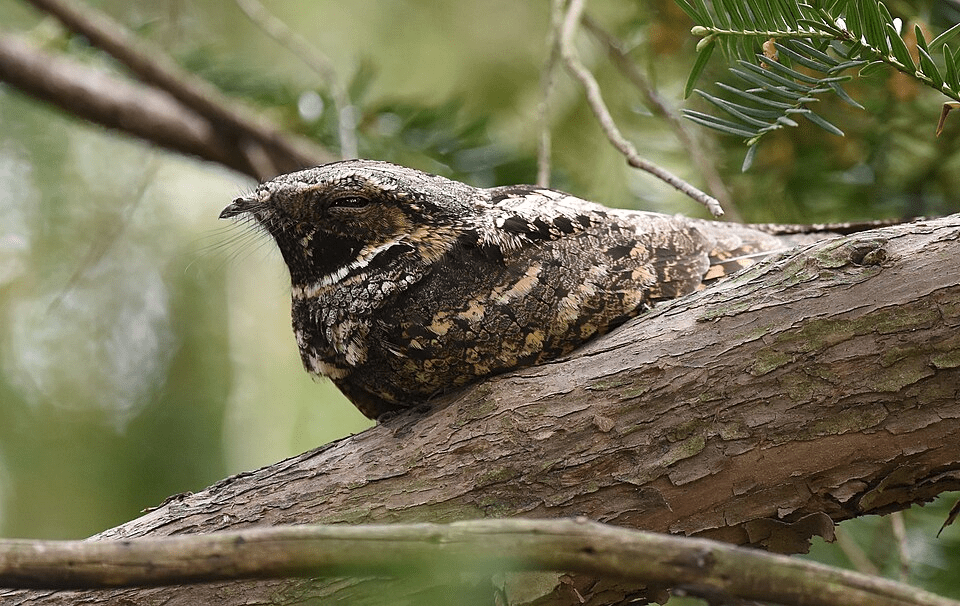
| Have you ever heard of a goatsucker? How about a nightjar? These odd compound words describe the same birds! Nightjars are a group of cryptically plumaged, nocturnal insectivores, belonging to the family Caprimulgidae. They feature earthen tones of browns, grays, and blacks to match tree bark, leaves, and other substrates. Their exceptionally wide mouths and small bills help them catch insects in flight under low light conditions. Of the 98 species found worldwide, nine can be found in the US. The Eastern Whip-poor-will (Antrostomus vociferus-translating to ‘noisy cavern-mouth’) is one of the most famous species in this lesser-known bird family. Americans have long recognized and cherished its iconic ‘whip-poor-will!’ song in the twilight or pre-dawn hour. As a symbol of rural America, the whip-poor-will is featured in a long list of folk and country songs as well as novels and poems. Eastern Whip-poor-wills spend their day stationary on the ground or on tree limbs, perfectly camouflaging against the bark or leaf litter. They awake at sunset and may begin singing loudly before engaging in feeding. They hunt for a wide array of insects from low perches, silently and rapidly darting out to catch bugs as they fly past, using their wide mouth to swallow insects up to two inches long. They can be found wintering on the Atlantic Coast, south from Virginia to Florida, along the Gulf Coast, and throughout Central America as far south as Costa Rica. Now through mid-May is your best chance to see one in Texas on its way to breeding grounds in the Midwest and Eastern US and Canada. Look (and more importantly, listen) for them in wooded habitats, particularly along open edges of shrubby thickets and young second-growth forests. If you spot a nightjar roosting, scrutinize carefully between the more regionally expected Common Nighthawk and Chuck-will’s-widow. Whip-poor-wills breed in many types of dry-decidous and evergreen-deciduous forests with little understory and access to open areas to forage in. They lay two eggs directly on the leafy ground in a shaded location. They often will not flush from the nest unless almost stepped on, making nest searching most challenging. At only eight days of age, the nestlings become well-camouflaged and are cared for by the male while the female often begins a second clutch. They rely on some degree of light to feed, meaning they are most active immediately following sunset and around first light. Through the moon’s brightest phases, they may feed all night long (making them ‘lunarphilic’). Whip-poor-wills time their nesting such that chicks will hatch 10 days before the full moon to allow for the most extensive hunting. Thus, your best strategy for locating one revolves upon the lunar cycle. Seek the brightest periods, especially the ten days leading to a full moon. Unfortunately, Eastern Whip-poor-wills are in decline, and an increasing proportion of Americans are unfamiliar with their songs. North American Breeding Bird Survey data indicates a 66% decline over the last 50 years. Loss of their open-understory forest habitat is a leading cause, due to a myriad of factors including development, agriculture, and fire suppression. Additional forested habitat can be created through regrowth of agricultural areas. Declines in insect abundance likely factor in their decline as well, as is true for most birds. |
Visit our Bird Gallery to read about other Texas birds!
 Houston AuduBlog