Common Nighthawk (Chordeiles minor) Family: Caprimulgidae By Will McDaniel The Common Nighthawk is a medium-sized member of the nightjar family ranging from 8.7 to 9.8 inches in length with wingspans between 20 and 24 inches. Excellently camouflaged in drab greys, browns, and blacks that blend into the shadows of tree bark and leaf litter, the […]
Black-crowned Night-Heron (Nycticorax nycticorax) Family: Ardeidae Black-crowned Night-Herons are small, stocky herons with short legs and necks. The adults are light gray with a distinct black back and crown, the face and underside are lighter yellowish white with an all-black bill and striking red iris. They also have long narrow white head plumes which can […]
By Schyler Brown, Conservation Specialist June 5th is World Environment Day, and for every minute in the day, a garbage truck’s worth of plastic will make its way to the ocean, harming countless wildlife. Plastic pollution is the accumulation of plastics to a quantity that is harmful to living organisms. Larger plastics can be mistaken […]
By Jesi Malowitz, Membership and Event Coordinator That’s a wrap! We met 97% of our $50,000 fundraising goal with $48,684.98 raised by our awesome Birdathon fundraisers! The teams’ hard work birding and fundraising really blew us away and we are so grateful to have such amazing supporters of Houston Audubon. Our awards celebration at the […]
Northern Rough-winged Swallow (Stelgidopteryx serripennis) Family: Hirundinidae By Will McDaniel, former Houston Audubon Coastal Conservation Technician The Northern Rough-winged Swallow is a small species ranging from 5 to 6 inches in length and a wingspan of 11 to 12 inches. Sharing the small head, tiny bill, and long pointed wings of other swallow species, these […]
Black Tern (Chlidonias nigera) Family: Laridae The Black Tern is probably the most aesthetically unique of the terns found in North America. While in breeding plumage the Black Tern has a fully black head, breast, and belly with gray wings and a small slender bill. In the non-breeding season this tern undergoes a significant plumage […]
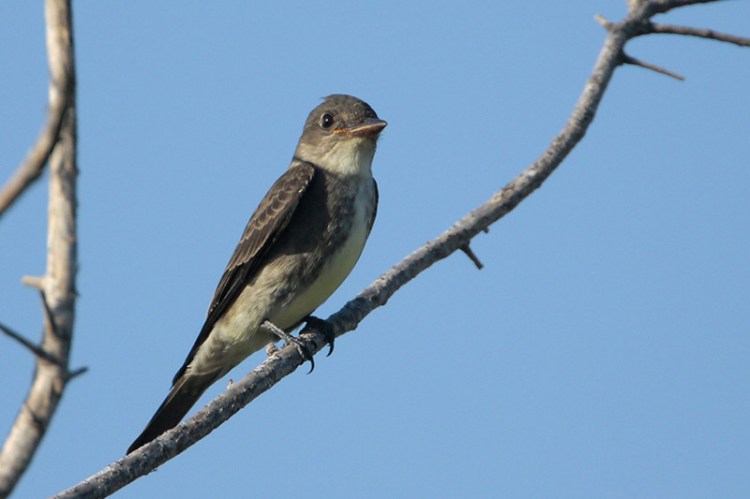
Olive-sided Flycatcher (Contopus cooperi) Family: Tyrannidae By Jon Piasecki, Houston Audubon Conservation Technician Olive-sided Flycatchers are one of the many species of flycatchers that can be found in the western hemisphere. This species winters in the northern half of South America and parts of Central America. During migration, these birds can be seen primarily throughout […]
Tennessee Warbler (Leiothlypis peregrina) Family: Parulidae By Carrie Chapin, Houston Audubon Conservation Technician The Tennessee Warbler is one of the many species to pass through the Upper Texas Coast during spring migration. This warbler was named because the first cataloged specimen was collected in Tennessee, but that is only one of the many states this […]
Buff-breasted Sandpiper (Calidris subruficollis) Family: Scolopacidae By Jon Piasecki, Houston Audubon Conservation Technician Buff-breasted Sandpipers have one of the longest migration journeys of any bird in North America. This species winters in the southeastern region of South America and breeds in the High Arctic around the northernmost parts of Alaska and Canada. Buff-breasted Sandpipers are […]
Hooded Oriole (Icterus cucullatus) Family: Icteridae By Carrie Chapin, Houston Audubon Conservation Technician A rare visitor to the eastern Texas coast, a Hooded Oriole was recently photographed in Boy Scout Woods Bird Sanctuary in High Island! Only staying for part of a day, this individual was one of the billions of birds that pass through […]




 Houston AuduBlog