By Stuart Nelson Get those picnics packed, binoculars polished, and hiking shoes laced up tight – spring migration is upon us! This special time of year, lasting roughly from March through May, and peaking in late April, brings over a billion birds through Texas, many of which stop along the Upper Texas Coast (UTC) to […]
By Sneed B. Collard III When my 13-year-old son Braden and I arrived at High Island in the spring of 2016, we quivered with anticipation. After two years of birding in our home state of Montana, we had finally decided to venture beyond our borders and attempt a modest ABA Big Year for ourselves. Our […]
Great Crested Flycatcher (Myiarchus crinitus) Family: Tyrannidae The Great Crested Flycatcher is a large perching bird in the large and diverse family of tyrant flycatchers. This bird is distinguished by its bright yellow belly and under-tail coverts (bottom of tail), dull white throat and namesake head crest. Although not extremely inconspicuous the Great Crested Flycatcher […]
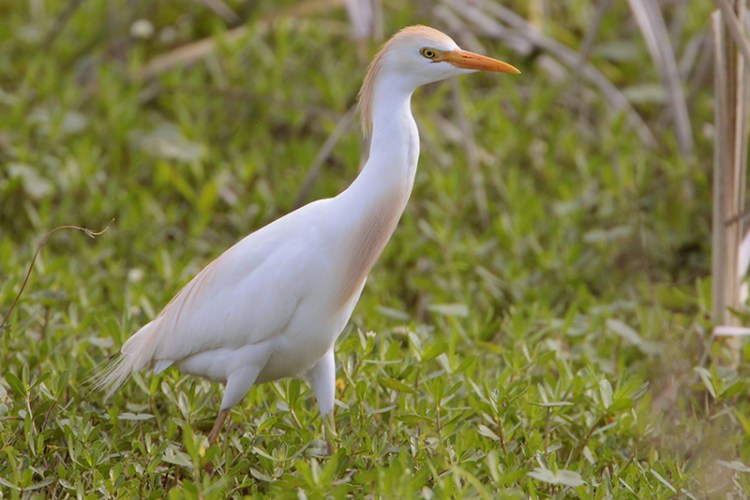
Cattle Egret (Bulbulcus ibis) Family: Ardeidae The stout white Cattle Egret is most often seen in fields rather than shallow water with other herons and egrets. It prefers to follow grazing cattle (hence the name) as well as tractors and mowers, snatching up small lizards and insects that scatter after the disturbance. The Cattle Egret […]
Eastern Meadowlark (Sturnella magna) Family: Icteridae The Eastern Meadowlark’s bright song is a familiar sound throughout open grasslands of eastern North America. They are commonly seen singing from fence posts, telephone wires, and shrubs. Eastern Meadowlarks can easily be identified by their brilliant yellow chests and dark v-shaped collar. These colors are slightly duller in the […]
Carolina Wren (Thryothorus ludovicianus) Family: Troglodytidae Our Beak of the Week is a favorite Houston resident, the Carolina Wren! Male and female Carolina Wrens look alike; both are reddish-brown above and warm buffy-orange below, with a long, slightly downcurved bill, a bold white eyebrow stripe, a rusty cheek, white throat, and a relatively long tail. […]
Yellow-crowned Night-Heron (Nyctanassa violacea) Family: Ardeidae Our Beak of the Week is the official Bird of Houston, the Yellow-crowned Night-Heron! This seemingly hunch-backed bird can be a difficult one to spot. Both species of North American night-herons, yellow-crowned and black-crowned, forage mainly at night and spend most of the day hidden among branches near a […]
Ruby-throated Hummingbird (Archilochus colubris) Family: Trochilidae Did you know that Ruby-throated Hummingbirds are able to fly in all 6 directions with wing beats of 53 times per a second? Ruby-throated Hummingbirds are bright emerald or golden-green on the back and crown with gray-white underparts. Males have a brilliant iridescent red throat while females and immatures […]
Chestnut-sided Warbler (Setophaga pensylvanica) Family: Parulidae The Chestnut-sided Warbler migrates through eastern Texas in spring and the boldly patterned male never fails to dazzle onlookers with his bright yellow crown, black line through his eye, black mustache stripe, white breast, and chestnut streaked flanks. The female has a similar pattern but is duller with a greener […]
Cedar Waxwing (Bombycilla cedrorum) Family: Bombycillidae Flocks of Cedar Waxwings are welcome winter visitors to the Houston suburbs where they feast primarily on berries. The Cedar Waxwing is one of the few North American birds that specializes in eating fruit; their digestive system is especially adapted to rapidly digest berries and they can survive on […]






 Houston AuduBlog