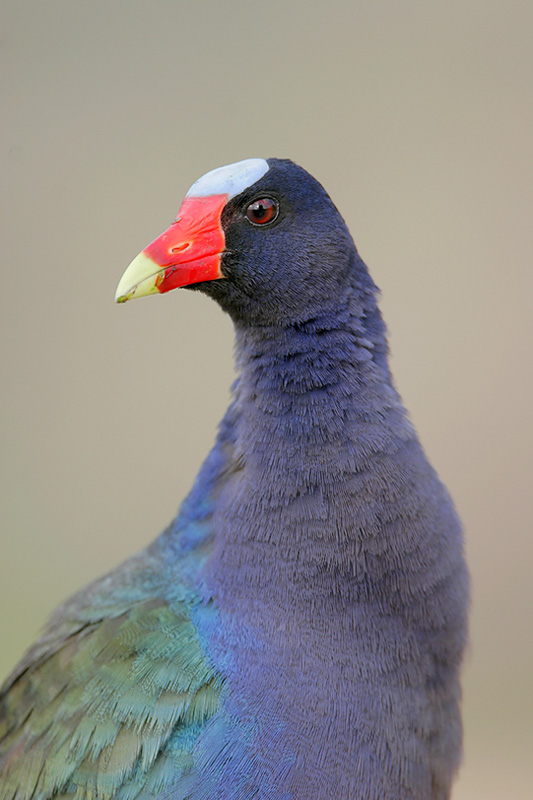
Purple Gallinule (Porphyrula martinica) Family: Rallidae By Grace Yaros, Houston Audubon Coastal Conservation Technician These multicolored, curious-looking birds are relatives of rails, and like many other rails are fond of wetland habitats with plenty of places to hide from potential predators. Adult Purple Gallinules have dark purple-blue heads and underparts, with a contrasting bright white […]
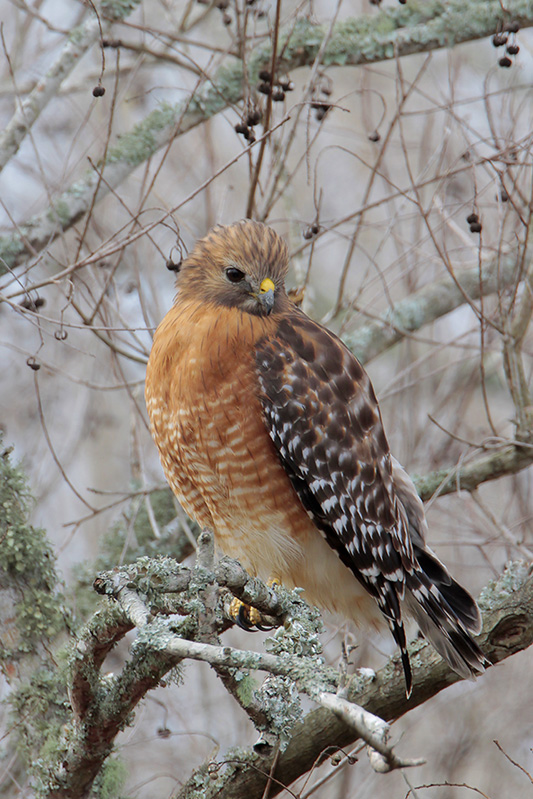
Red-shouldered Hawk (Buteo lineatus) Family: Accipitridae By Grace Yaros, Houston Audubon Coastal Conservation Technician These boldly-marked hawks are as fierce as they are handsome. Adult Red-shouldered Hawks are distinctive, with bright reddish-brown chests and bellies, brown heads, and bold black-and-white wings with red shoulder patches. Immature birds are brown above and white below with broad […]
Black-necked Stilt (Himantopus mexicanus) Family: Recurvirostridae By Grace Yaros, Houston Audubon Coastal Conservation Technician Black-necked Stilts are striking, elegant shorebirds; they are white below with black wings, backs, and heads. Their exceptionally long legs are bright bubblegum pink. They are quite vocal and conspicuous, especially during the breeding season. Black-necked Stilts favor shallow, open wetlands […]
American Crow (Corvus brachyrhynchos) Family: Corvidae By Grace Yaros, Houston Audubon Coastal Conservation Technician In celebration of Black Birders Week, this week we are highlighting the fascinating world of corvids! American Crows are a familiar sight across most of the United States and Canada. They may be found in almost any habitat, and eat a […]
Clapper Rail (Rallus crepitans) Family: Rallidae By Grace Yaros, Houston Audubon Coastal Conservation Technician Clapper Rails can often be difficult to spot as they forage among dense saltmarsh grasses, and catching a glimpse of these handsome rails is certainly a treat! They are named for their calls: a series of loud, repeated “kek” calls. They […]
By Schyler Brown, Houston Audubon Conservation Specialist In 2000, the United Nations (UN) announced that the 22nd of May would be celebrated as the International Day for Biological Diversity. The significance of the proclamation was to celebrate the adoption of a framework intended to protect biological diversity across multiple levels of biological organization. So what […]
Canada Warbler (Cardellina canadensis) Family: Parulidae By Grace Yaros, Houston Audubon Coastal Conservation Technician A flash of gray and yellow in the understory will alert you to the presence of a Canada Warbler searching for its next meal! These medium-sized warblers are blue-gray above and yellow below. They have bold white eye-rings and yellow markings […]
By Grace Yaros, Houston Audubon Coastal Conservation Technician This Friday, May 17th marks a very special holiday– Endangered Species Day! Celebrated annually on the third Friday in May, Endangered Species Day was created to raise awareness about endangered species and the threats they’re facing, as well as to celebrate conservation efforts that have led to […]
Bobolink (Dolichonyx oryzivorous) Family: Icteridae By Grace Yaros, Houston Audubon Coastal Conservation Technician Bobolinks are handsome, fairly small blackbirds. Females are golden overall with blackish streaks on their backs, sides, and crown, including a line behind their eye. Breeding males are distinctive: they are black with mostly white backs and a golden nape. During the […]
By Schyler Brown, Houston Audubon Conservation Specialist “Ethical behavior is doing the right thing when no one else is watching – even when doing the wrong thing is legal.” – Aldo Leopold I will not pretend for a second that I knew what the bird was. In fact, upon spotting it on our way out […]





 Houston AuduBlog