
By Schyler Brown, Conservation Specialist, Houston Audubon
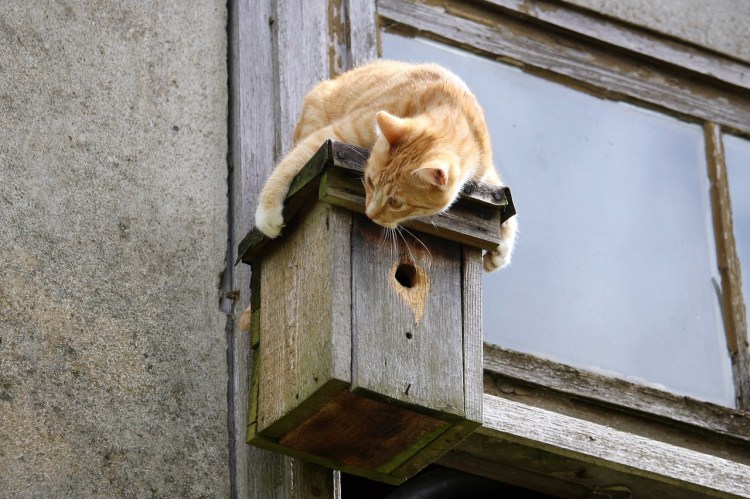
We at Houston Audubon want to say Happy International Cat Day! Many of us at Houston Audubon have pet cats and love them dearly. However, we are aware of a looming problem that involves cats… Let’s cut to the chase- cats are the number one cause for the decline of birds (around 4 billion birds a year) and many other types of wildlife1. Despite how cute and sweet our feline friends may appear, they are actually very capable of turning birds into poultry flavored cat treats. Let me be clear though–in no way are we blaming this problem on cats. In fact, outdoor and stray cats are in just as much danger as the wildlife they prey on. The problem is irresponsible policies and unaware (albeit well-meaning) cat owners. Let me explain.
Often, cats are let outside, or even kept outside, to keep rodents out of barns. In this scenario, there are few other cats to fight with, and few cars to get hit by. In a city like Houston, however, the opposite is true. 75% of stray and outdoor kittens die before they are even six months old due to disease, vehicle strikes, starvation, and a slew of other terrible endings2. Most outdoor cats do not even make it to their second birthday. In Houston, practices such as trap/shelter-neuter-release (TNR and SNR) and cat colonies are commonly used with the goal of reducing the stray cat population and creating humane environments for cats, but they are not effective. Let me reiterate: TNR/SNR and cat colonies do little to solve the ghastly conditions outdoor/stray cats experience.
In reality, cat populations are not limited by disease, competition and reproduction. In ecological terms, we would say that stray/outdoor cats are not a density-dependent species, which means that removing their ability to reproduce through TNR and SNR does nothing to stop the problem of cat overpopulation 3,4. Furthermore, cat colonies only exacerbate the problem of disease infestation and competition, because providing food, water, and shelter does little to stop these factors from burdening stray/outdoor cats5.
This awful reality has led many pet organizations and animal rights groups to advocate for keeping cats indoors. Not only is this beneficial for cats, but it is critical to the wildlife that naturally populate our city. Celebrate International Cat Day by keeping your cat indoors! Consider a Catio, a patio designed for cats that reduces risks to wildlife. Finally, vote for policy that recognizes cats as an invasive species3. If you want to learn more about the issue of stray/outdoor cats, please see our webpage Cats Indoors or reach out to sbrown@houstonaudubon.org.
Literature Cited
- Loss S.R., Will T., Marra P., The impact of free-ranging domestic cats on wildlife of the United States. (2013) Nature Communications. 4:1396 https://doi.org/10.1038/ncomms2380
- Nutter F.B., Levine J.F. Stoskopf M.K. Reproductive capacity of free-roaming domestic cats and kitten survival rate. (2004) Journal of the American Veterinary Medical Association. 1;225(9) 1399-402. doi: 10.2460/javma.2004.225.1399
- Lepczyk C.A., Dauphine N., Bird D.M., Conant S., Cooper R.J., Duffy D.C., Hatley P.J., Marra P.P., Stone E., Temple S.A., What Conservation Biologists Can Do to Counter Trap-Neuter-Return: Response to Longcore et al. (2010) Conservation Biology. Comment. DOI: 10.1111/j.1523-1739.2009.01426.
- Crawford H.M., Calver M.C., Fleming P.A., A Case of Letting the Cat out of The Bag- Why Trap-Neuter-Return is Not an Ethical Solution for Stray Cat (Felis catus) Management. (2019) Animals 9:4, 171. https://doi.org/10.3390/ani9040171
- Lepczyk C.A., Haman K.H., Sizemore G.C., Farmer C., Quantifying the presence of feral cat colonies and Toxoplasma gondii in relation to bird conservation areas on O’ahu, Hawai’i. (2020) Conservation Science and Practice. 2(2) DOI:10.1111/csp2.179

