
By Schyler Brown, Houston Audubon Conservation Specialist

Dr. Kelsey Biles and I (Schyler Brown) run a bird banding station as part of the Monitoring Avian Productivity and Survivorship (M.A.P.S) program. This program is a nationwide initiative to understand avian populations via bird banding and recapture data during the breeding season. To capture breeding birds, we use mist nets; nearly invisible nets with fine black threads woven into small holes that tangle the unsuspecting flying birds. We band birds at the Carolyn Raizes Davis Sanctuary in Liverpool, Texas. This sanctuary south of Houston is bordered by the Chocolate Bayou and consists of mixed pine and hardwood forests, with prairie easements cutting through the sanctuary. On any regular day in the breeding season, we catch Northern Cardinals, Carolina Wrens, and White-eyed Vireos. All banding and sampling is being conducted under a federally authorized bird banding permit issued by the U.S. Geological Surveys Bird Banding Lab.
Banding and trapping wildlife has taught Kelsey and I something very important about nature: it’s rough. Most wild animals do not make it to adulthood. Nature is a brutal element to survive in, and unless an animal was born lucky (under the right circumstances, and with some genetic edge), it will likely die before it reproduces. Because of these hardships, it is somewhat rare for ornithologists to capture an individual bird more than once. So, we were especially surprised when we caught an adult male cardinal with only one leg on three separate occasions this breeding season! Let me share with you a story about a handicapped bird whose resiliency taught me that with enough determination, anything is possible.

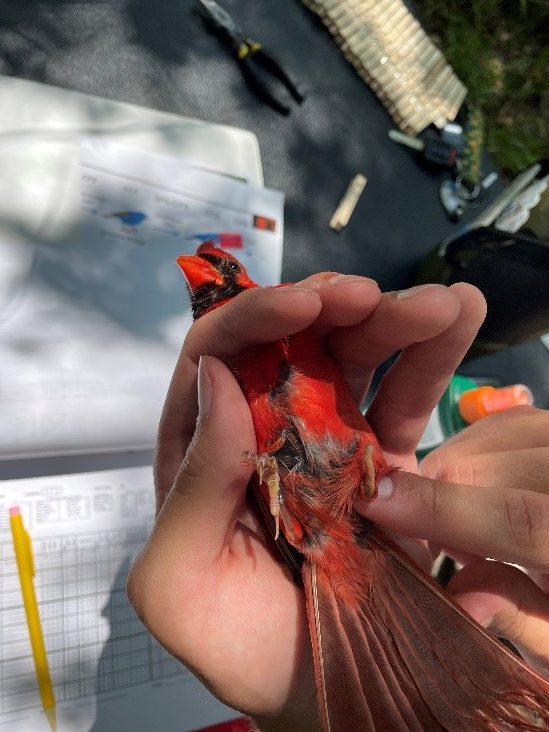
Our first instance of catching this one-legged cardinal was not especially surprising to us, as we catch handicap birds from time to time. This was our first day of banding though, and this was our first bird of the season, so we were a little taken aback. In the middle of the sanctuary, in net 5, I saw a bright red male Northern Cardinal struggling to free itself from the tiny black threads it was caught in. Immediately noticing he was missing a leg, I took extra care untangling and pulling the bird from the net.
Above Map of CRD nets and areas where Legolas was caught
Back at the station we banded the bird with a special steel band. Typically, birds are fit with uniquely-coded aluminum bands provided by the USGS. Northern Cardinals, however, receive hardened steel bands because they have powerful biting capabilities that can crush the usual aluminum bands. While banding this cardinal, we pondered how long he may have been missing the leg. It was well-healed, and he looked healthy overall; he was of average weight and size. He must be determined to survive, we thought. We decided to name him Legolas, a name befit his injury, after one of our favorite fantasy novel characters. While we did not expect to see him again, we wished him luck as we watched him fly away with his shiny new bracelet.
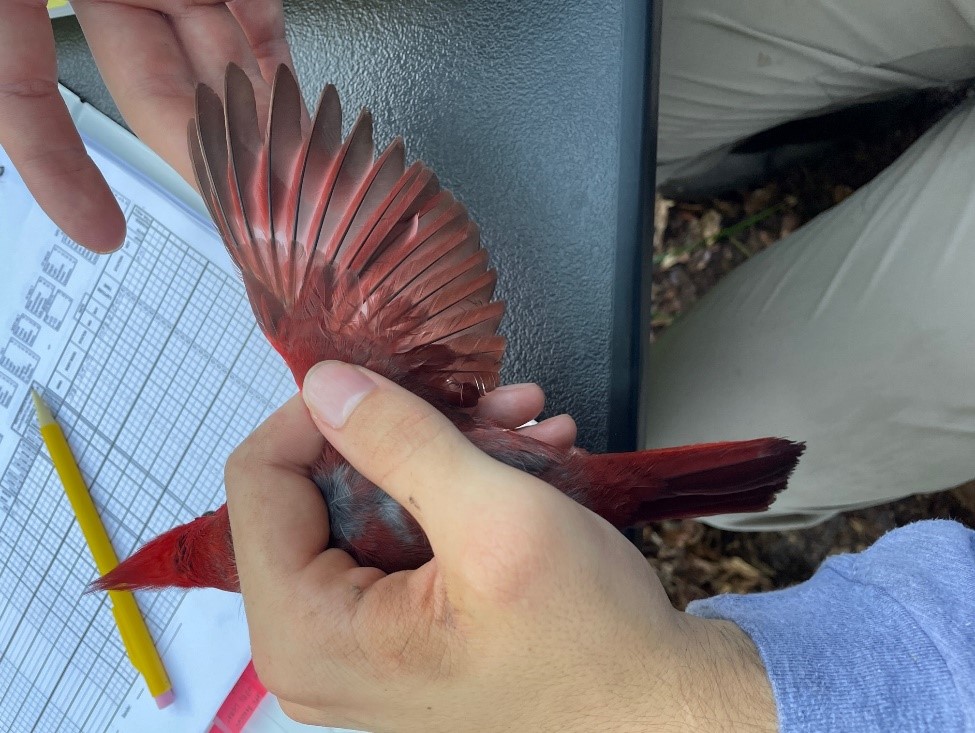
We didn’t see Legolas for a couple of weeks, but this is typical as the breeding season continues. Adult birds become more difficult to catch as they remember net locations and tend to stay very close to the nest when their chicks are young. In place of the adults we began to catch fledgling birds- young Carolina Wrens and Northern Cardinals who tend to be more relaxed in the nets, not aware of the dangers posed by the world they were brought into. For these reasons, we were doubly surprised to find our old friend Legolas struggling in net 10 on the north-eastern side of the sanctuary! Not only did he survive the weeks between capture, but he was in an entirely different part of the sanctuary! This could mean that despite his handicap, he could be a healthy, competitive male who gets to use large portions of a habitat. He was not happy to see us, and tried biting and flailing about to try to free himself. While getting his measurements (weight, wing length, etc) we wondered with excitement how he could be doing so well out here with just one leg! Unfortunately, we did notice that much of his plumage was in rough shape this time, which often indicates lack of food, or fighting with other birds. We let him go with hope in our hearts.

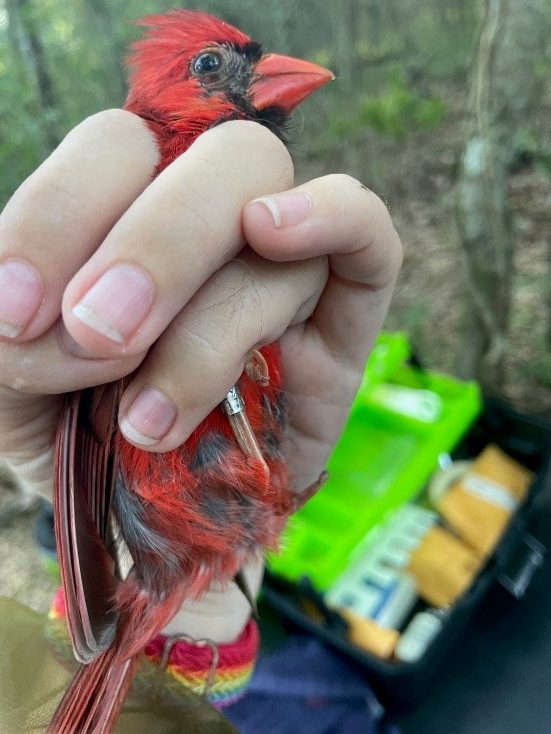
Fast forward a couple of weeks, and we find ourselves in late July amid a brutally hot and humid summer, few birds singing as they try to stay cool under the shade of trees. Both adults and young are aware of the nets, and aren’t interested in flying around in the extreme heat anyways. We wouldn’t be banding much longer, as the season was coming to a close. Our typical number of captures this time of year is just a couple of birds a day. This particular day was quite disheartening, as the miles and miles of walking continually yielded no birds in our nets. As I slogged my way back to the banding station, I see Kelsey with a bird in hand and excitement in her eyes- she couldn’t wait to tell me that we had once again caught Legolas! We were thrilled to have this determined little fighter join us once more, and again we gawk at the fact that he is still alive and well. Upon this third capture, we couldn’t help but wonder if this bird could be a father to any of the young scrappy birds we had been catching… this could only be determined by close study of the behavior of the birds in the sanctuary, or by genetic analysis. We would never know, but we have our suspicions and hope to see Legolas again in the next breeding season!


I keep revisiting this post as I have been monitoring and trying to care for a northern cardinal with an injured leg (with advice from my local wildlife rescue). I have named her Kimmy after Unbreakable Kimmy Schmidt …though I changed it to unBEAKable. I hope Legolas enjoyed his life, he brings hope to a cardinal and a human in Toronto.
LikeLike