

Buff-bellied Hummingbird (Amazilia yucatanensis)
Family: Trochilidae
By Theresa Kelly, Houston Audubon Coastal Conservation Technician
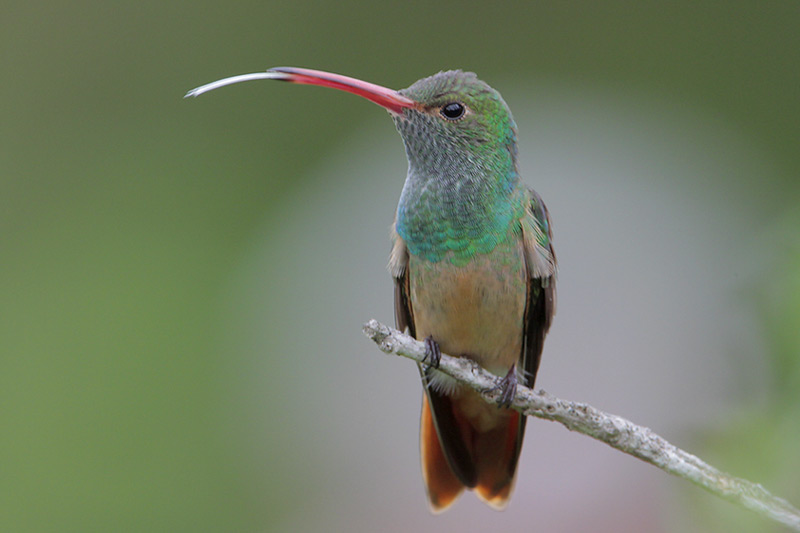
Hummingbird identification can be notoriously difficult, largely due to their small size and plumage similarities between different species. This week’s Beak of the Week, the Buff-bellied Hummingbird, is no exception, though adults possess several characteristics that set them apart from their Trochilid kin. With green on the head and back, a sandy belly, an iridescent blue-green throat, and a rufous tail, the Buff-Bellied is a riotous mix of color. A bright red bill with a dark tip helps distinguish adult Buff-bellied from similar hummingbirds, although juveniles’ bills are often darker and less distinct. Juveniles are also duller overall, with a more grayish breast. Compared to other US hummingbirds, the Buff-bellied is fairly large and possesses a moderately long bill, tail, and wings. Their most frequent calls are a dry tik common to hummingbirds and sharper, higher tsi-we or siik calls which are often made during display flights.
Buff-bellied Hummingbirds live in lowland habitats, preferring shrubby and wooded areas such as woodland edges, scrubby fields, parks, and even suburban or urban gardens given sufficient presence of flowering plants. Although hummingbirds are known for feeding on flower nectar, they often get the majority of their nutrients from insects. They can use their long, thin beaks to hover over and pluck up small insects such as flies and caterpillars, or they may hunt insects on the wing (a behavior known as flycatching). Similar to a butterfly’s proboscis, a long, transparent tongue helps the Buff-bellied Hummingbird consume nectar from various plant species, including tropical sage, aloe vera, papaya, and shrimp plant. Aggressive around food sources, Buff-bellied Hummingbirds will often chase smaller hummingbirds away with loud see-see-see-see calls, although it is unclear whether this behavior is associated with either sex or related to nesting territoriality. Despite their diurnal habits, Buff-bellied Hummingbirds have been known to feed at night.
Largely residential, Buff-bellied Hummingbirds may migrate short distances. Some move south from Texas to Mexico in the wintertime, while others may move northward to winter along the central Gulf Coast. A relatively rare visitor to the Houston area, Buff-bellied Hummingbirds have been found in local counties sporadically: most recently, an individual was seen this past December near the High Island field station (shout out to Nick Minnich!). Feeders are always a good way to attract hummingbirds, but strategic gardening can allow you to provide food and shelter for Buff-bellied Hummingbirds in particular. Turkscap, Anacua, and Coral Bean (Erythrina herbacea) are preferred food sources that will brighten up your yard, while Texas ebony, hackberry, willow, and ash are native nesting favorites.


Visit our Bird Gallery to read about other Texas birds!
 Houston AuduBlog
Oh My ❗️ what a beak it is 🙂
LikeLike