

Caroline Nixson, Volunteer Coordinator, Houston Audubon
Houston may be known for its freeways and skyscrapers, but it’s also a city shaped by water, sky, and the creatures that move through both. Perched at the intersection of coastal prairie, piney woods, bottomland forest, and estuarine wetlands, the Bayou City is uniquely positioned at a vibrant ecological crossroads. As a result, we see a major hub of bird migration not just in the spring, but again in late summer and fall, as birds make their way back across the Gulf to their wintering grounds in Central and South America.
This seasonal movement includes one particularly charismatic flier: the Purple Martin, North America’s largest swallow. These aerial acrobats migrate all the way to the Brazilian Amazon Basin for the winter, returning north in late February through May to breed. Incredibly, the same birds often return to the exact area they nested the year before, and if their young find suitable housing, they will too. Once they fledge, adult Purple Martins begin to congregate in roosts.
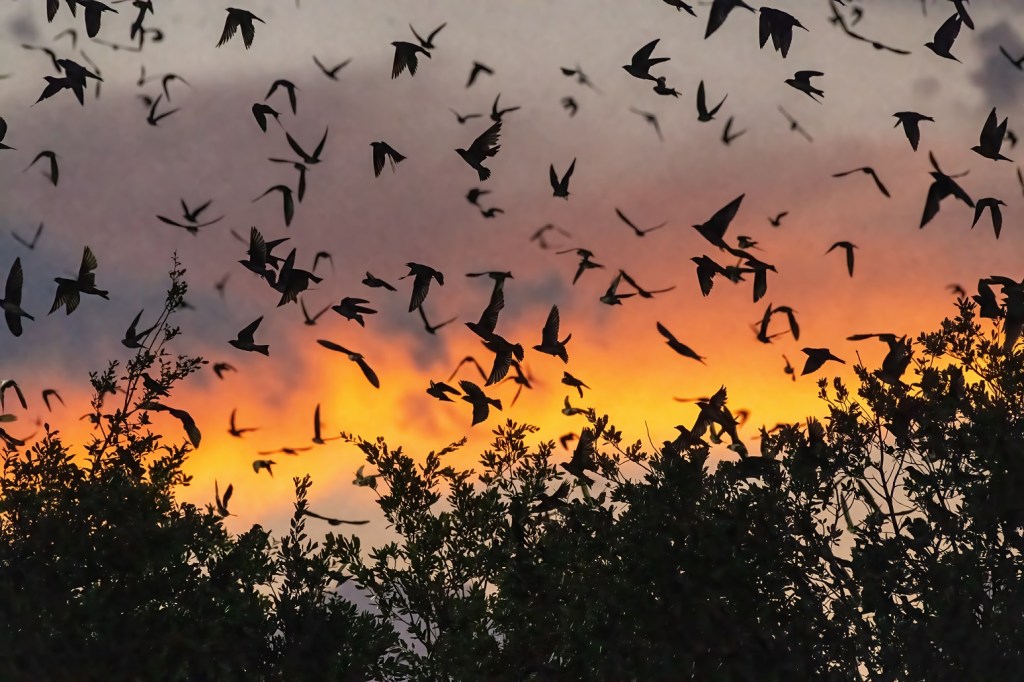
Each summer in Houston, thousands of martins gather in communal roosts, often choosing the most unexpected places—like the oak trees in a shopping center parking lot. Despite Houston’s rapid development and constant construction, birds still find space in our city. It’s a reminder of how deeply wildlife is woven into the fabric of this place, if we know where to look—or when to look up.
Humans have long shared space with Purple Martins. For centuries, Indigenous peoples carved gourds to house these birds. In the Houston region, these were the Karankawa, Atakapa, and Akokisa peoples, who used our bayous and streams to navigate the landscape. Purple Martins are obligate cavity nesters, and across the eastern United States they now depend almost entirely on human-provided structures to breed. If no such housing exists, they will not nest in that area—meaning their presence is shaped by our choices.
But even with all of Houston’s concrete and construction, the Purple Martins keep coming back.
Many people assume that Purple Martins are here to help with Houston’s infamous mosquito problem, but that’s a common myth. Martins only feed while flying, and mosquitoes don’t fly high enough to be of interest. Instead, martins are generalist foragers, catching whatever insects are active at their altitude—dragonflies, flies, stinkbugs, cicadas, bees, wasps, moths, butterflies, and others. They are most active on warm, dry evenings when flying insects are abundant. After a rainy June, the return of the heat may be uncomfortable for us, but it means plenty of bugs in the air for the martins to eat.
And believe it or not, the same radar used to track rain can also detect large numbers of birds in flight, especially when they’re all taking off at once. Just before dawn, Purple Martins rise from their roosts and disperse in every direction. On radar, this creates a distinct circular pattern known as a “roost ring.” These are visible on NEXRAD Level II radar, which provides high-resolution atmospheric data.
If you’re curious and want to see it for yourself, you can! Here’s how:
Track Purple Martin Roosts with Radar from Your Computer
Step-by-step guide:
- Download NOAA’s Weather and Climate Toolkit
https://www.ncdc.noaa.gov/wct/ - Open the app and select:
- NEXRAD Level II
- Amazon as the server
- KHGX – Houston, TX (or your local radar station)
- Date/time (the NOAA data uses UTC — aim for 5:30–6:30 AM local time)
- Click “List Files” and select the relevant time range.
- Hit “Animate”, then “Load”, and wait for the files to render.
- Watch the radar animation — and look for that expanding doughnut-shaped burst: it’s the martins taking off.
- Optional: Use “Export Movie” to save your animation as a GIF.
Want a printable version of these steps? Download our radar guide here or email us for help!
You Don’t Have to Wait for a Watch Party
Purple Martins gather every night, not just when we host events! One of the beautiful things about birding is how accessible it can be — especially in a city like Houston. You don’t need binoculars, hiking boots, or even to leave your car.
Here’s how to experience the magic yourself:
- Arrive at the parking lot just before sunset
- Roll down your window or bring a chair
- Watch the sky above the trees
- Marvel at the swirling waves of thousands of birds
Bring a friend, a camera, or just your sense of wonder.
Want to learn more or attend a Watch Party?
Check out houstonaudubon.org/purplemartins for upcoming dates, locations, and volunteer opportunities. Whether you’re a seasoned birder or just bird-curious, you’re welcome here.
Let’s celebrate the incredible wildlife of the Bayou City — even in the most unexpected places.
Frequently Asked Questions
Our Purple Martin Watch Parties bring together birders, families, photographers, and first-time visitors every summer — and they always come with curious questions. Here are some of the most frequent ones:
Why are they roosting here?
The birds have chosen a cluster of tall live oaks in an urban parking lot. It’s a bit surreal to witness, but common for Purple Martins. Roost trees in warm, lighted, open urban environments can offer protection, retained heat, and reliable landmarks — all of which may contribute to their appeal. They return to the same trees year after year.
Are they nesting?
No — they’re roosting, not nesting. Nesting happens in spring, in specially built colony houses or gourds. These birds have already fledged their young and are now gathering at night in massive flocks to rest and feed ahead of migration.
Where do they go during the day?
They disperse widely across the region to forage, sometimes traveling dozens of miles. You might see them along bayous, fields, lakes, or urban green spaces — wherever insects are flying high.
Where are they headed? Where did they come from?
Many birds at this roost likely nested somewhere in or around Texas. Others may have come from further north — Purple Martins are known to use southern roosts as staging sites ahead of their fall migration. Their ultimate destination? The Amazon River basin, where they’ll spend the winter.
How many birds are there?
There’s no official count, but it’s safe to say many thousands. Some roosts in the U.S. reach into the tens of thousands. The roost here grows larger week by week until the final migration push!
 Houston AuduBlog