

American Oystercatcher (Haematopus palliates)
Family: Haematopodidae
By Spencer Poling, Houston Audubon Coastal Conservation Technician
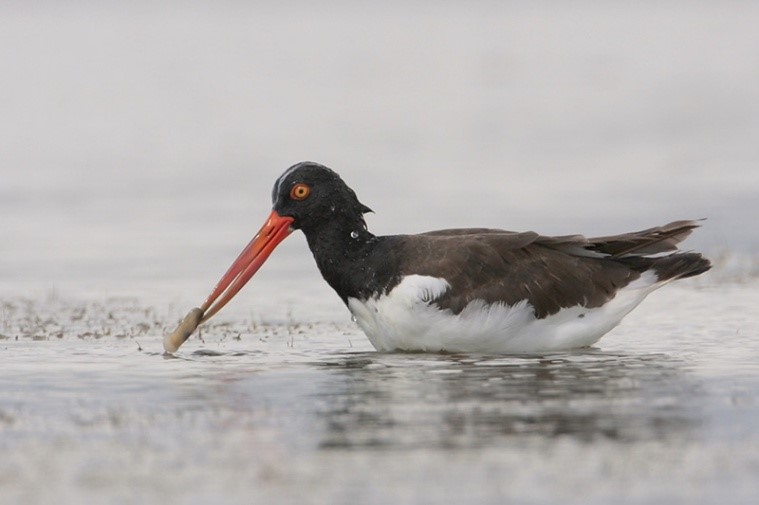
This week’s Beak of the Week, the American Oystercatcher, is one that would be difficult to confuse with any other species in the area. Oystercatchers, family Haematopodidae, are known to frequent coasts around most of the world and for their bright orange bills, pink legs, and bright eyes. American Oystercatchers are one of two Oystercatchers of North America and differ from Black Oystercatchers through their counter-shading white belly and brown back. They have striking yellow eyes and contrasting red skin around their eyes, known as the orbital ring. American Oystercatchers show sexual dimorphism in the same way as many shorebird species, in which the females tend to have slightly longer bills than males. This allows for females to reach invertebrates at further depths than males and reduce resource competition between them.
As apparent by their name and specialized beaks, American Oystercatchers almost exclusively eat oysters and other mollusks. This specialized diet limits their feeding habitat to coastal ecosystems such as rocky shorelines and tidal flats. During high tide, you will see them return to their roosts and nesting sites further up shore, in salt marshes, or in between dunes on barrier islands. In these habitats, you may see their eggs, which are a buffy gray color with dark speckles, often in clutches of 2-4. Shorebirds, including American Oystercatchers, sometimes nest directly on sand in the open, so look out for eggs when walking along the coast during the breeding season! Look forward to the springtime where you may see males and females in courtship, walking side by side and giving quick piping notes.
Like many shorebird species, American Oystercatchers are vulnerable to coastal development (#SaveBolivarFlats), but due to the establishment of many protected habitats along coasts the last few decades, they have been trending up in population and are considered a species of least concern. They can be found year-round along the Texas coast and are a resident of Houston Audubon’s Bolivar Flats Shorebird Sanctuary.

Visit our Bird Gallery to read about other Texas birds!
 Houston AuduBlog