

Hooded Merganser (Lophodytes cucullatus)
Family: Anatidae

By Colleen McDonough, Houston Audubon Coastal Conservation Technician
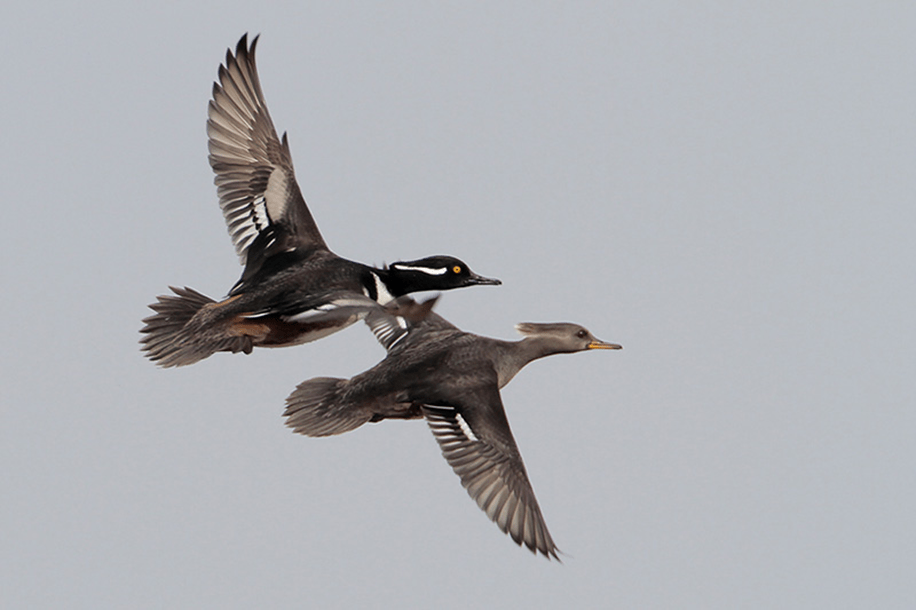
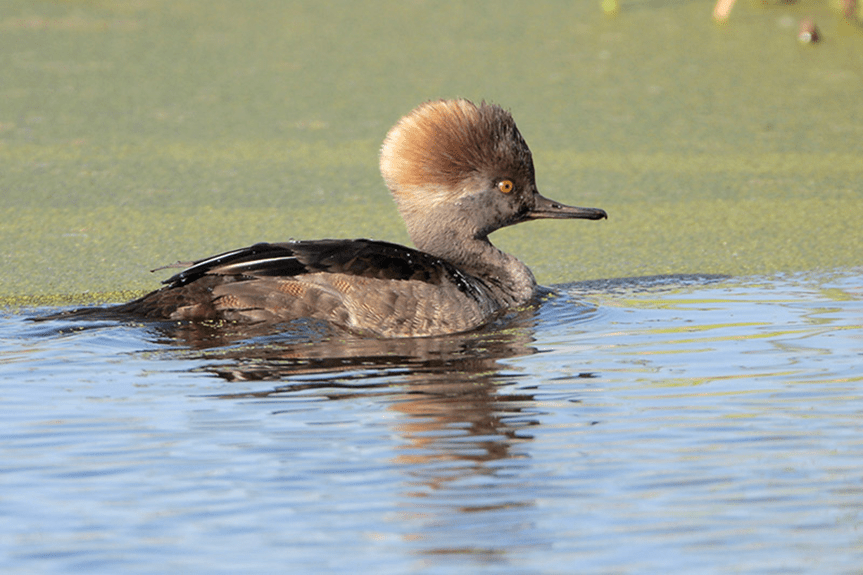
Sporting a ridiculously large crest, the Hooded Merganser could never not stand out in a pond! Breeding males have striking black and white patterning while females are cinnamon colored. Hooded Mergansers are the smallest of the mergansers found in the Americas, similar in size to a mallard. They are mostly silent outside of the breeding season. Males will croak like a frog while displaying to females as part of a fascinating ritual that also involves extending their magnificent crests and thrashing their heads up and down.
Hooded Mergansers are found year-round in forested lakes and ponds across most of the eastern United States, with some migrating short distances to winter along the Gulf Coast. As cavity nesters, adults choose holes made by woodpeckers in mature trees to build their nests in. They will also utilize man-made nest boxes. Female Hooded Mergansers are known to lay eggs in other ducks’ nests, part of a strategy known as brood parasitism, which is common among cavity-nesting duck species. Females lay up to thirteen eggs and are solely responsible for incubation. The mother merganser leaves the nest within a day of her eggs hatching, and the ducklings must make a courageous jump to join her, fluttering straight to the ground sometimes over fifty feet!
Compared to other merganser species, the Hooded Merganser has more variety in its diet, eating small fish, crustaceans, mollusks, plants, aquatic insects and amphibians. They can dive for up to two minutes, propelling themselves with their feet and spotting prey with eyes well adapted to seeing underwater. The serrated edges on their bill helps them keep a solid grip on slippery prey.
Hooded Mergansers are found in Texas only in the winter months. Coastal wintering birds are known to spend time in brackish estuary habitats, including those found across Galveston County. Hooded Mergansers are often seen in the ponds visible from S.E. Gast Red Bay Sanctuary, which is an underrated site for spotting a variety of shorebirds, waterfowl and forest birds alike!
Visit our Bird Gallery to read about other Texas birds!

