

Belted Kingfisher (Megaceryle alcyon)
Family: Alcedinidae

By Spencer Poling, Houston Audubon Coastal Conservation Technician
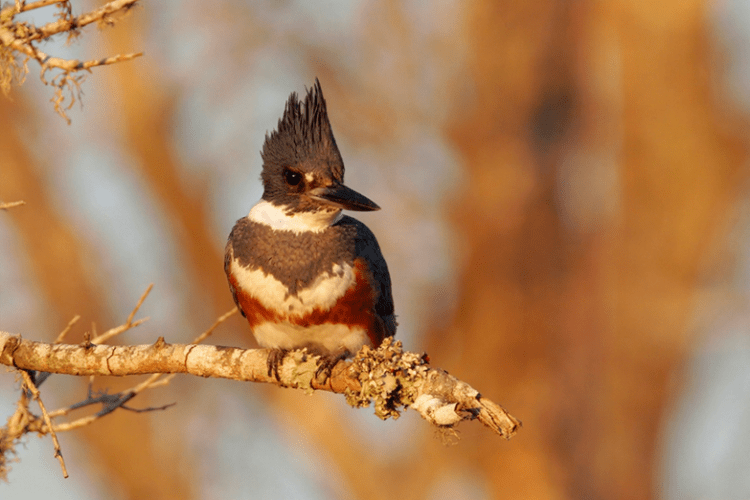
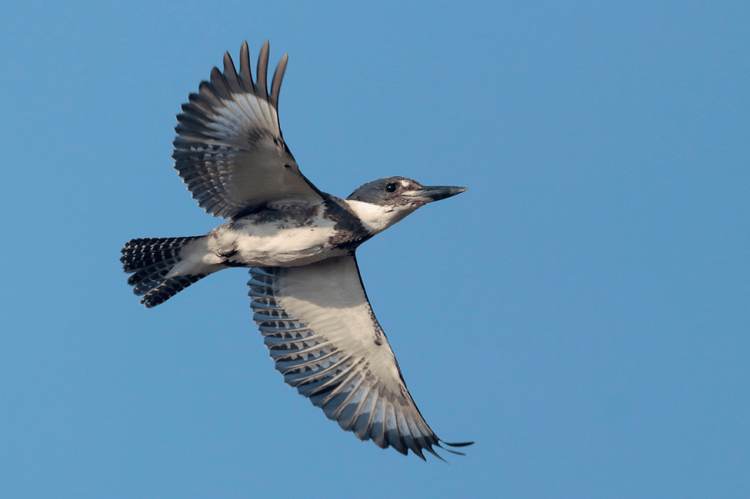
Belted Kingfishers are common and widespread, yet they’re eye-catching birds whose presence is often hard to miss! Their stocky bodies, large heads, and bulky bills make Belted Kingfishers easy to recognize, yet it’s usually their loud, rattle-like call that announces their presence first. Another standout feature of Belted Kingfishers is their beautiful, contrasting colors. Males can be identified by their white bellies with a blue breast band, while females sport an additional rufous band. This makes Belted Kingfishers one of the few, yet special, bird species that exhibit reverse sexual dichromatism, where females stand out more than males.
As their name suggests, Belted Kingfishers primarily eat fish, though they are also known to eat aquatic insects and other aquatic animals like frogs and crayfish. This means that any body of water, such as lakes, rivers, and wetlands, is often a suitable habitat to find them. Unlike herons and egrets, who elegantly use their long necks to catch fish, Belted Kingfishers are known to hunt fish through a dramatic, headfirst dive into the water. This makes clear water another important habitat requirement for these small, flashy fishermen so that they can spot their prey from a raised perch.
When birding these habitats, you may notice a small tunnel dug into the side of a bank; this could mean that you’ve just found a kingfisher nest! Both males and females can be seen playing equal roles in the nesting process, including both digging their tunnel, incubating their 5-8 eggs, and feeding their young.
Belted Kingfishers can be found in all of Houston Audubon’s High Island bird sanctuaries, as well as Bolivar Flats Shorebird Sanctuary and Edith L. Moore Nature Sanctuary! Hopefully, these fun facts resonate the next time you spot a kingfisher and inspire you for an extra moment to appreciate how special they are!
Visit our Bird Gallery to read about other Texas birds!
 Houston AuduBlog