
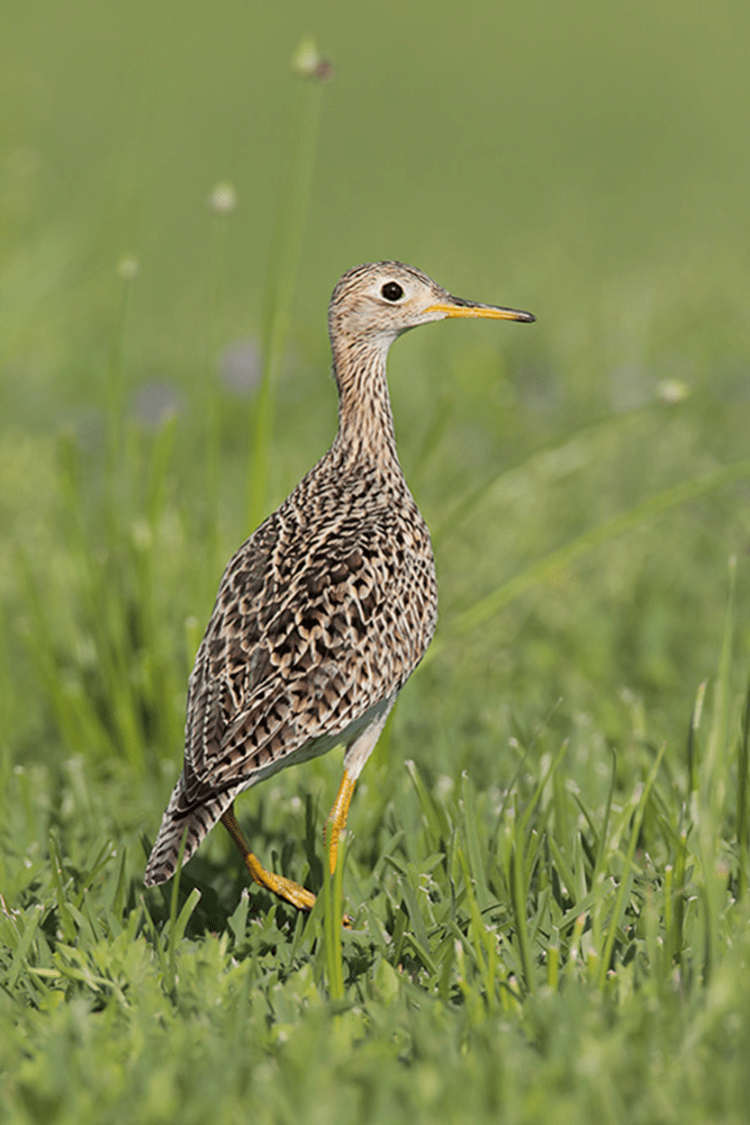
Upland Sandpiper (Bartramia longicauda)
Family: Scolopacidae

By Robert Buckert, Houston Audubon Coastal Conservation Technician
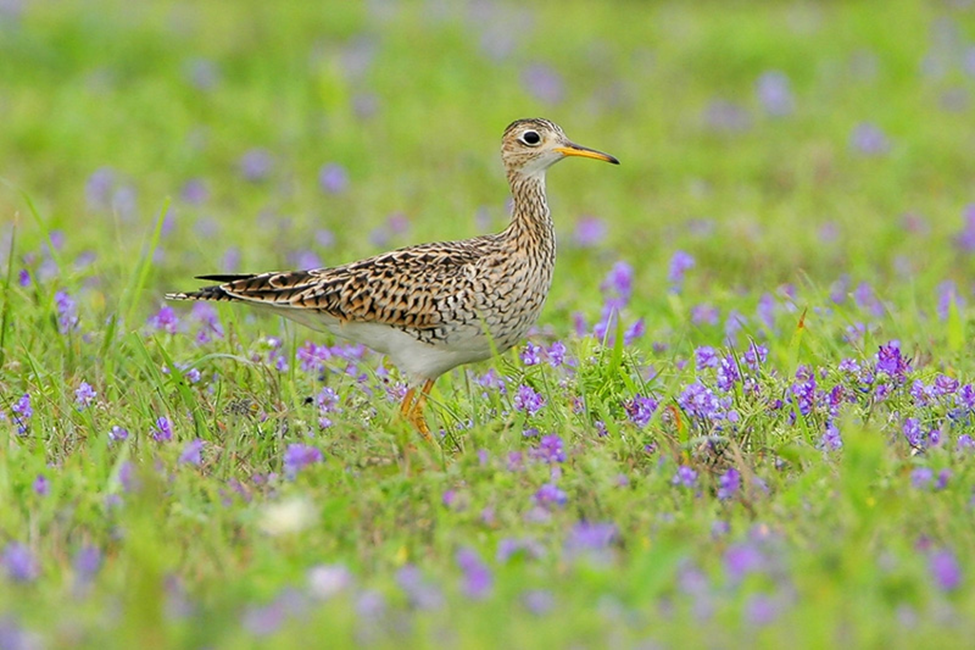
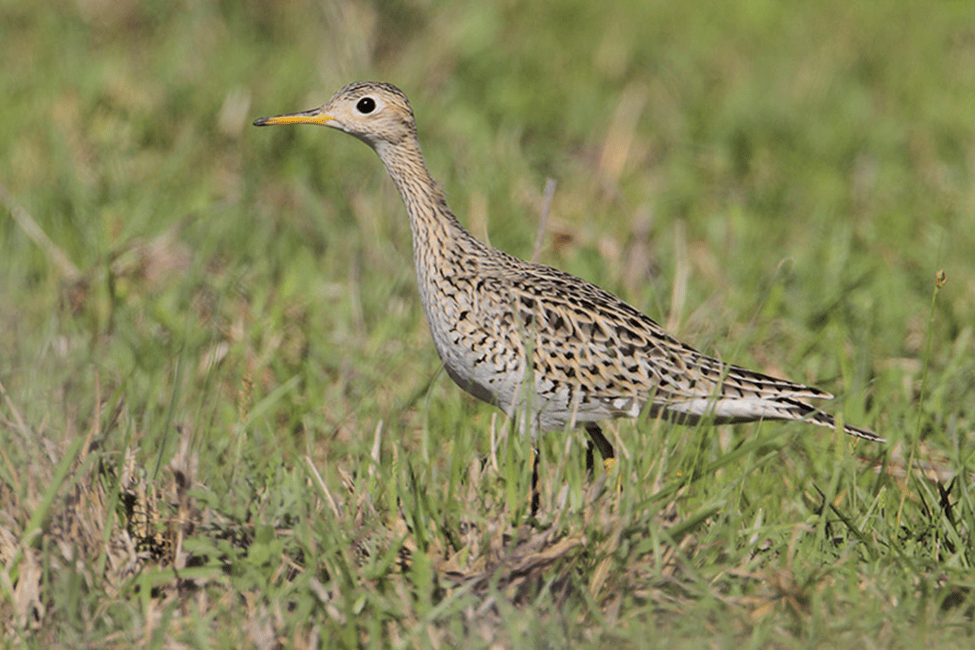
| The Upland Sandpiper is a medium-sized shorebird that’s easy to overlook at first glance, but leads a fairly unique life. As a sandpiper that spends its entire life in grassland habitats, it is one of only a few terrestrial shorebirds. Preferring shortgrass prairies, Upland Sandpipers utilize a vast array of grassy habitats. They are densest in native prairies of the Great Plains, but are also found readily in pasturelands and fallow agricultural fields. In the far north of their range, they breed in mountain meadow and upland tundra. In the East, they are found in low density in blueberry barrens, airfields, and peatlands. They primarily consume insects and other invertebrates, but occasionally eat seeds and berries of these low plants. Their gurgling, whistled song (often called a wolf whistle) is an iconic element of the American prairie and a key aspect of their elaborate courtship. Males sing while circling over the territory, with shallow wingbeats, before landing and calling from the ground with wings raised. Pairs perform this flight display together, circling and landing abruptly in unison. In some areas, nests are in close proximity, appearing colonial. Their nests consist of a lined scrape, begun by the male and finished by the female. Two to seven eggs are laid, and the young are precocial, meaning they are active at hatching and able to feed. Both parents participate in brooding and remain with their young for roughly a week. The adults will perform distraction displays to lure predators away from nests or young. As with many of their closest relatives, they are impressive long-distance migrants. From their northern breeding grounds, they head to the vast Pampas Plain of South America, across northern Argentina, Uruguay, and southern Brazil. Lucky for us, Texas falls on this route and you may have a chance to spot one returning north during mid-March to early May. Check eBird for recent sightings and scan grassy fields, especially following inclement weather which causes them to ‘fallout’ from their migration. With their unique combination of long yellow legs, dovelike head, thin yellow bill, and streaky, golden upperparts, they are hard to confuse with other species. Learning their bubbly flight call is especially useful in locating them. Every year during fall migration, an extremely bizarre casualty occurs. Some Upland Sandpipers migrate to the Ozogoche lagoons of southern Ecuador, where hundreds plunge into icy water at high speed, certain to die. The reason for the occurrence is unknown but is considered a ‘sacred suicide’ by local indigenous groups who prepare a ceremonial feast with the birds. Overall, their populations have increased throughout the 19th century alongside deforestation, reaching such abundance that market hunters shipped them to the East in boxcars by the thousands. Today, the species is considered stable at 750,000; however, they are experiencing localized declines in over two dozen states and provinces. These declines are driven by grassland habitat loss to agriculture, development, and reforestation, as well as increasingly harsh agricultural practices, often using chemicals. |
Visit our Bird Gallery to read about other Texas birds!


Interesting post and awesome photos.
LikeLike