
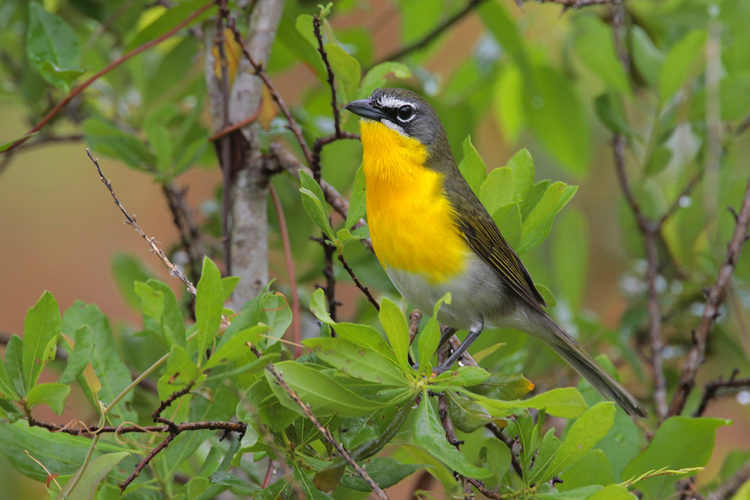
Yellow-breasted Chat (Icteria virens)
Family: Icteriidae

By Robert Buckert, Houston Audubon Coastal Conservation Technician
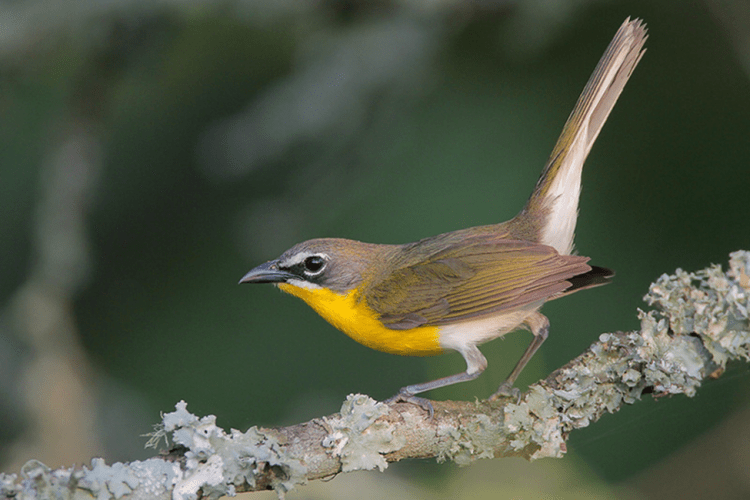
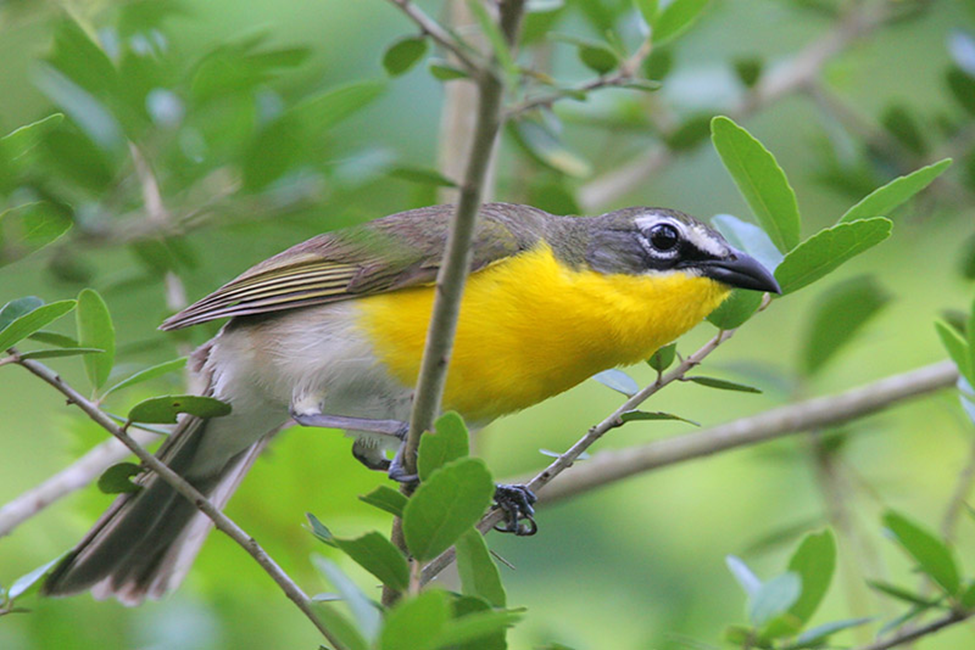
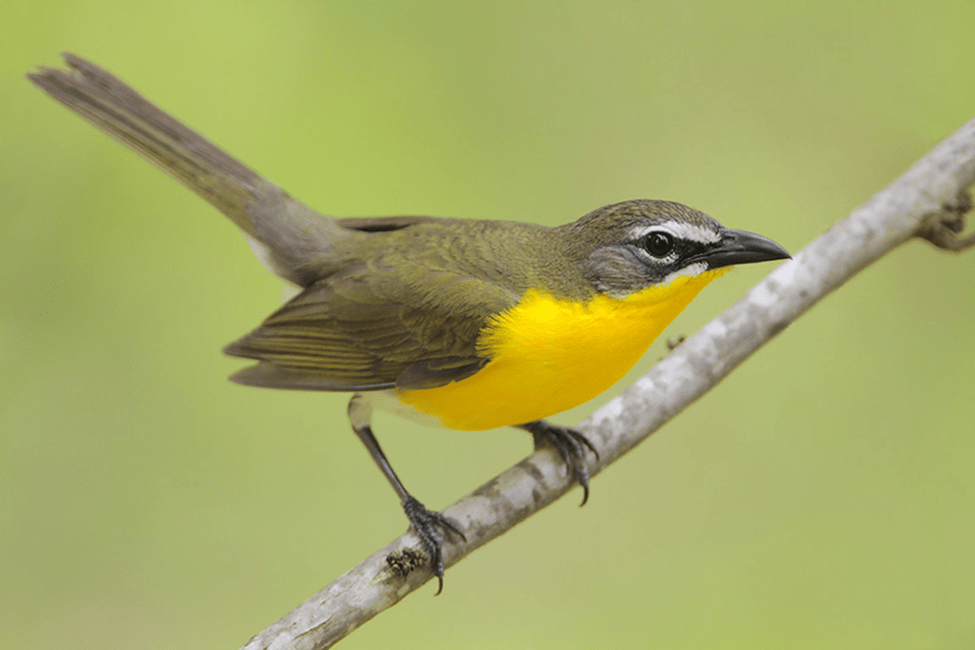
| Chuck! — toop-toop-toop-toop — jedek! — chrrrr —- cherk! This strung out set of onomatopoeias is our best attempt at describing the song of the enigmatic Yellow-breasted Chat (proudly featured on our High Island patch of 2007). Perhaps more useful than assigning syllables to each section of the song, their vocalizations are described as a strung out set of rattles, grunts, gurgles, whistles, and catcalls. As expressive as their songs may sound, their appearance fits the bill as well. Their bold facial patterning consists of white spectacles and malar, which contrasts their thick, dark bill, giving them an inquisitive, animated look at all times. Combined with their medium size, bold yellow breast, and olive-green upperparts, the chat is unlikely to be confused with other species. The Yellow-breasted Chat boasts a unique history due to uncertainty in its taxonomic placement. Chats now stand apart from most American avifauna as members of their own monotypic family, Icteriidae (not to be confused with Icteridae (New World Blackbirds). This makes the chat one of only three bird species found in the US that are the sole representatives of their families; the other two being the Limpkin (Aramidae) and the Olive Warbler (Peucedramidae). Ornithologists had formerly classified the chat as a warbler, falling under the family Parulidae (New World Warblers). Though due to its much larger size and distinctive behaviors, it was always the oddball of this family. In 2017, the American Ornithological Society reclassified the chat following genetic data. To complicate matters even further, a most intriguing individual was discovered in San Bernardino, California, appearing to be a hybrid between a chat and some species of oriole. Following extensive documentation and genetic analysis, it was determined to be a hybrid Yellow-breasted Chat x Hooded Oriole. Though hybrids are quite rare, it is expected for one to result from parent species sharing a genus (commonplace in ducks, sparrows, and warblers). This bird is especially significant as chats and orioles do not currently share the same genus or even family, and inter-family hybrids are exceedingly rare. Orioles belong to Icteridae, which is a broad family encompassing blackbirds, orioles, and meadowlarks, and the chat’s family Icteriidae is placed ‘sister’ to it, meaning they are each other’s closest related families. Digging out of the taxonomic weeds, you will likely have to dig through some real-life weeds in order to find a chat. Your time is now, as they are only found on the Texas coast during migration. Chats winter in Central America, from Mexico through Costa Rica, and are currently returning to their breeding grounds. Their habitat preference is one of shrublands and old fields composed of dense thickets across the southern, midwestern, and western US. In more arid, western regions, they are found in the riparian scrub. They are seldom seen well, slinking through these largely impenetrable tangles, so you are most likely to hear them. Your best chance at a good view is catching a male prominently singing over a breeding territory, at times performing a fluttering display from a high perch. Their population of roughly 17 million ranks them relatively low in conservation concern, though they have experienced a ~32% decline from 1966 to 2019. Shrubland can be a volatile habitat, intermediate between grasslands and forests, requiring an intermediate level of disturbance to be maintained in some areas. Chats became prevalent in the northeast US following logging and farm abandonment, though are now rare as forests have regenerated and open spaces are increasingly developed. Due to these localized decreases, they are listed as species of concern in some states. Interestingly, the western populations have grown somewhat proportionately to the declines in the east as well, as is true for most birds. |
Visit our Bird Gallery to read about other Texas birds!

