

By Lili Banta, Wildlife Photographer
A Least Tern descends on folded wings toward its chick, a small silver fish curved in its bill. The chick, a powder-puff bundle of gray down, stretches upward. The sky, the sand, the wings, everything is in perfect alignment. It is a photograph that required extraordinary patience, the right light, and a bird cooperative enough to keep doing what it was going to do anyway: feeding its young.
What the image cannot show is everything happening just outside the frame.
A Tiny Bird with a Difficult Life
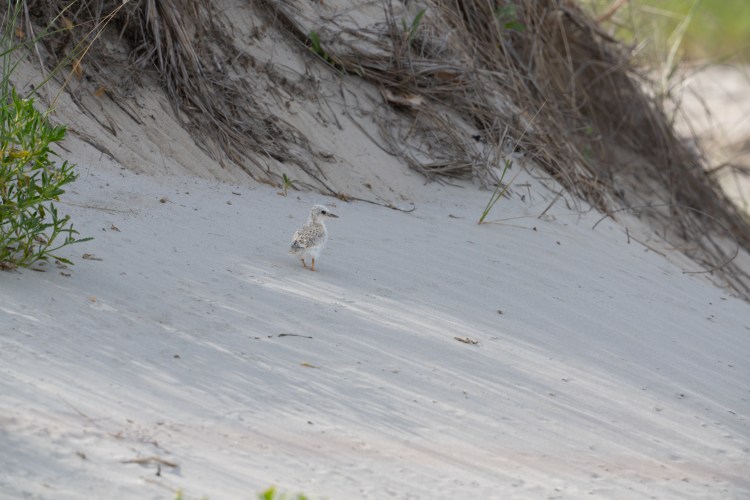
The Least Tern (Sternula antillarum) is North America’s smallest tern — roughly 8 to 9 inches long and weighing about 1.4 to 1.9 ounces, not much heavier than a handful of coins. It spends its winters along tropical coasts as far south as Brazil, then flies north each spring to breed on the same exposed, sandy beaches it has used for millennia.
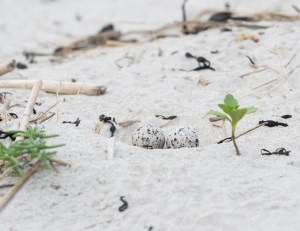
On the Upper Texas Coast, nesting begins in spring and continues through summer. The nest itself is almost invisible: a shallow scrape in the sand, sometimes lined with a few pebbles or bits of shell, the eggs camouflaged so effectively that even experienced birders step over them. That concealment is the Least Tern’s primary defense. It has almost no other.
Threat 1: Beach Disturbance
Human activity on beaches is the most pervasive and well-documented threat to Least Tern nesting success. When people or dogs walk through or near a nesting colony, the adult birds flush from their nests. Those brief absences matter. In moderate temperatures, exposed eggs can begin to overheat within minutes under the Texas sun. In cooler conditions, they can chill. Either way, incubation is interrupted and chick survival rates fall.
Off-leash dogs are a particular concern. Studies and field observations consistently flag dogs as one of the most frequent causes of nest abandonment in beach-nesting bird colonies. A dog moving at speed through a colony doesn’t have to touch a single egg to cause a cascade of failures. Houston Audubon and its partners respond by placing symbolic fencing around active nesting areas along the upper Texas coast from March through August each year — not to block beach access, but to signal to beachgoers that something fragile and irreplaceable is happening nearby.
Threat 2: Predation
Least Terns are colony nesters, which provides some protection: a group of adults can mob and deter many predators. But the same human development that crowds their nesting habitat has also inflated local populations of their most effective enemies. Raccoons, rats, coyotes, feral cats, and domestic dogs thrive in coastal communities. Unlike natural predator populations, these animals don’t cycle through boom-and-bust years in sync with tern productivity, they’re subsidized by human trash and pet food year-round.
A single predator working through a colony in a single night can end a season’s breeding effort entirely. Houston Audubon’s coastal partners have experimented with electric fencing around the most vulnerable sites to deter coyotes in particular, a measure that has shown real promise where it’s been deployed.
Threat 3: Sea-Level Rise and Intensifying Storms
The long-term picture is harder. Least Terns need open, sparsely vegetated beach high enough above the tide line to avoid inundation. Sea-level rise is gradually shrinking this real estate. As barrier islands erode and beaches narrow, the zone of suitable nesting habitat compresses.
Intensifying storms make an already precarious situation worse. When Hurricane Beryl made landfall in July 2024, partners monitoring Galveston Bay estimated they had lost essentially all of their Black Skimmer nests for the season. Least Tern colonies in the same region faced similar pressure. For a bird that will renest if its first clutch fails, an admirable resilience, there is a limit to how many catastrophic events a single season can absorb.
Climate scientists have flagged the Least Tern’s vulnerability specifically: the majority of its current Gulf Coast habitat is projected to be affected by even moderate sea-level rise. Higher temperatures also mean eggs left briefly unattended face faster overheating, compounding the harm done by every flush from a passing walker or dog.
What You Can Do
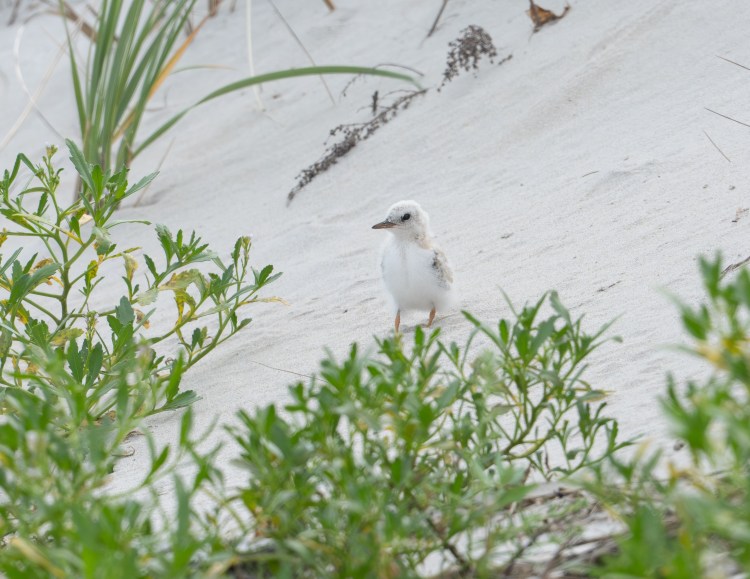
The conservation math is unusually direct for this species. Unlike threats driven by distant industrial forces, the most immediate pressures on Least Terns during nesting season are ones that individual beachgoers can change today.
Keep dogs leashed on and near nesting beaches. This is the single highest-impact behavioral change most visitors can make. Check local ordinances: many Texas beaches already require leashes in or near nesting areas.
Respect symbolic fencing. If you see orange stakes and flagging tape, assume an active nest is nearby. Give the area a wide berth even if you cannot see eggs or chicks.
Report new nest locations and disturbances. Houston Audubon’s Beach-Nesting Bird Program monitors the upper Texas coast and wants to know what you see. Visit houstonaudubon.org to find out how to report sightings and support stewardship efforts.
Talk to people around you. Field observations consistently show that most disturbance is unintentional. People who know what the fencing means, and why it’s there, almost always adjust their behavior. You don’t need to be confrontational, just informative.
Support habitat protection. Longer-term, addressing sea-level rise and storm impact requires policy-level action. Backing conservation organizations working on coastal habitat and climate resilience, including Houston Audubon, is how individual concern translates into landscape-scale change.
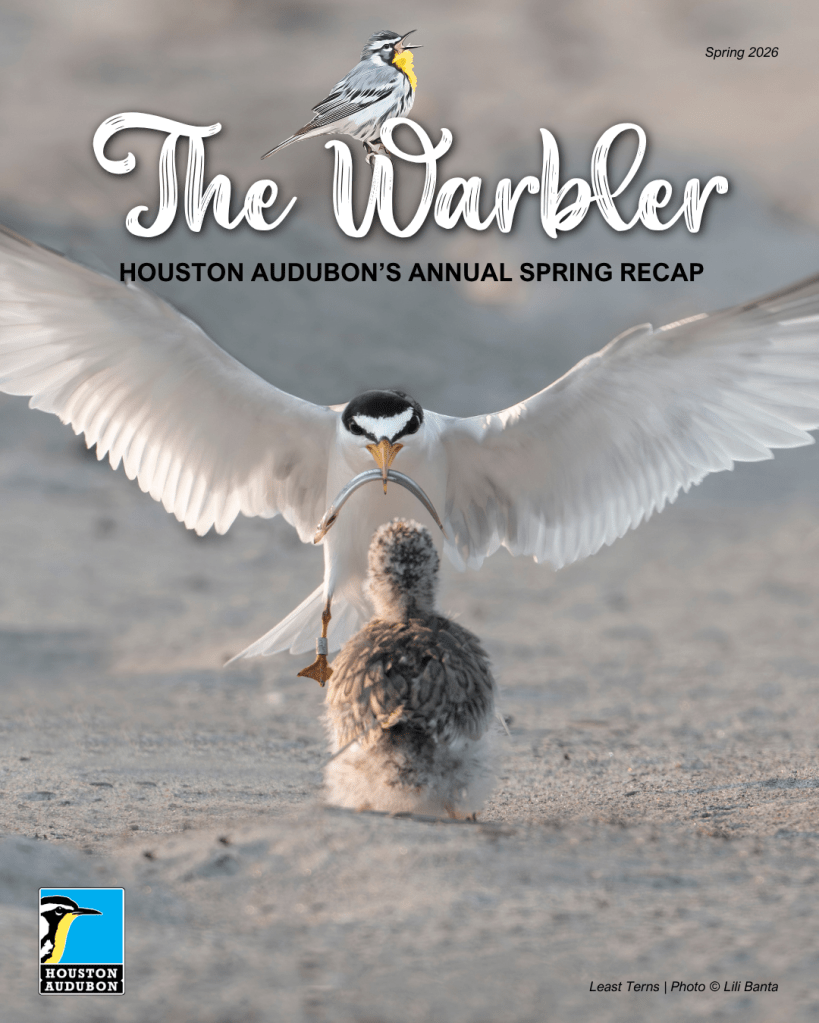
The cover photograph shows what we are trying to protect: a moment of small, ordinary wildness, a parent feeding a chick on an open beach. The Least Tern has survived market hunters, coastal development, and decades of disturbance. It is resilient, adaptable, and still here. Whether it stays here depends, in part, on what happens just outside the frame of every photograph taken this season.
This story was featured in the 2026 edition of The Warbler, Houston Audubon’s Annual Spring Recap. Read it here.

