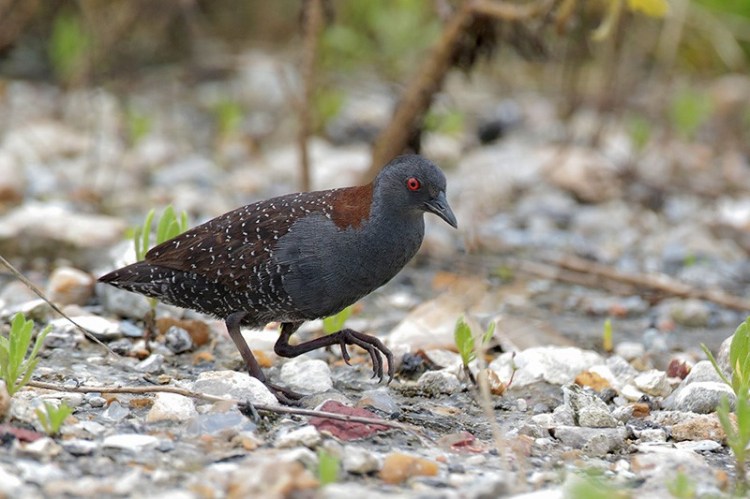
Black Rail (Laterallus jamaicensis) Family: Rallidae By Robert Buckert, Houston Audubon Coastal Conservation Technician This week’s beak is held by the smallest rail in North America. Similar in size to a sparrow, the Black Rail is one of the most highly sought-after and difficult species to spot, proving infamously elusive as it buries itself in […]
Reddish Egret (Egretta rufescens) Family: Ardeidae By Colleen McDonough, Houston Audubon Coastal Conservation Technician The Reddish Egret is North America’s rarest (and likely most eccentric) heron. An array of fast-paced and erratic hunting movements makes these birds stand out boldly among other wading species. Reddish Egrets are found almost exclusively near saltwater and brackish wetlands, […]
By Diego Lopez, Houston Audubon Young Professionals Advisory Council 2025 Community, Celebration, and Conservation were the main themes of Houston Bird Week 2025! During the 7th annual Bird Week, a total of 38 events were held across the Houston region which attracted over 2,000 participants. These events, which included bird walks at the Edith L. […]
American Oystercatcher (Haematopus palliates) Family: Haematopodidae By Spencer Poling, Houston Audubon Coastal Conservation Technician This week’s Beak of the Week, the American Oystercatcher, is one that would be difficult to confuse with any other species in the area. Oystercatchers, family Haematopodidae, are known to frequent coasts around most of the world and for their bright […]
Loggerhead Shrike (Lanius ludovicianus) Family: Laniidae By Colleen McDonough, Houston Audubon Coastal Conservation Technician The Loggerhead Shrike, nicknamed “butcherbird”, is a songbird with unexpected carnivorous tendencies. Similar in size to a cardinal, shrikes are mostly gray with a black eye mask, hooked bill, and white wing patches visible in flight. The Loggerhead Shrike is one […]
Caroline Nixson, Volunteer Coordinator, Houston Audubon Houston may be known for its freeways and skyscrapers, but it’s also a city shaped by water, sky, and the creatures that move through both. Perched at the intersection of coastal prairie, piney woods, bottomland forest, and estuarine wetlands, the Bayou City is uniquely positioned at a vibrant ecological […]
By Melissa Stappen, Houston Audubon Member Soil and sun and water, oh my! How do they all add up to a beautiful, flowering, peaceful space to share? Where do we start? That was the question when Josh and I moved to Fresno, Texas, from the northeastern states. We purchased a wonderful home with a sort […]
By Sharon Young, Friends of Keegans Bayou Trail As part of the Witness Series event, “Blooming into History: Beautiful, Fierce and Free,” held on April 26, 2025, Houston Audubon staff Jed Aplaca and Carolyn Klein led a walk that helped participants identify wildflowers, grasses, pollinators, and birds along Keegans Bayou Trail in southwest Houston. Among […]
By Kassandra Robles, Art Teacher, Elsik High School This spring, our students from Alief ISD’s Elsik High School had the incredible opportunity to visit Smith Oaks Bird Sanctuary with Houston Audubon, a first for us, and hopefully the beginning of something that continues to grow. As an art teacher in one of Houston’s most diverse […]
Wyatt Egelhoff, Sanctuary Manager and Victoria Parker-Thacker, Seasonal Coastal Avian Technician, Houston Audubon Shortly before the woods fill with migrating songbirds, Houston Audubon staff spring into action, readying the beaches of the Bolivar Peninsula for the arrival of our beach-nesting birds in mid-March. For over a decade, Houston Audubon has monitored and stewarded several key […]



 Houston AuduBlog