Wyatt Egelhoff, Sanctuary Manager and Victoria Parker-Thacker, Seasonal Coastal Avian Technician, Houston Audubon Shortly before the woods fill with migrating songbirds, Houston Audubon staff spring into action, readying the beaches of the Bolivar Peninsula for the arrival of our beach-nesting birds in mid-March. For over a decade, Houston Audubon has monitored and stewarded several key […]
Article and photos by Amanda Jerng I recently collaborated with Houston Audubon to host our first bird walk for students at Cullinan Park, an event that ranks among the most inspiring experiences of my life. I had so much fun sharing everyone’s excitement, talking to parents about the origins of their children’s interest in birds, […]
By Christine Wehrli, Community Outreach Programs Manager In March, amidst preparation for all things spring migration this year, I received some unfortunate news. I would need to get knee surgery after tearing my ACL and menisci in a rugby game. This meant 7 weeks of crutches and a non-weight bearing left leg, which also meant […]
By Jesi Malowitz, Development Manager, Individual Giving, Houston Audubon Standing at Platform A at the Smith Oaks Rookery on Bolivar Peninsula, I fix my binoculars on a Roseate Spoonbill clumsily landing on a nest over Claybottom Pond. In its bill is a carefully chosen stick to add to its nest. As the spoonbill searches for […]
Cape May Warbler (Setophaga tigrina) Family: Parulidae By Theresa Kelly, Houston Audubon Coastal Conservation Technician This week’s Beak of the Week may be more easily recognized by its common name — Cape May Warbler — but its taxonomic species tigrina is a more apt descriptor. Adults boast a bright yellow face, breast, and belly, with […]
Green Heron (Butorides virescens) Family: Ardeidae By Nick Minnich, Houston Audubon Coastal Conservation Technician This week’s Beak is often referred to as “daggerlike,” a perfect tool in the hunt for fish and amphibians. Green Herons are a short, compact heron who often prefer to stand on water’s edge vegetation as opposed to wading in the […]
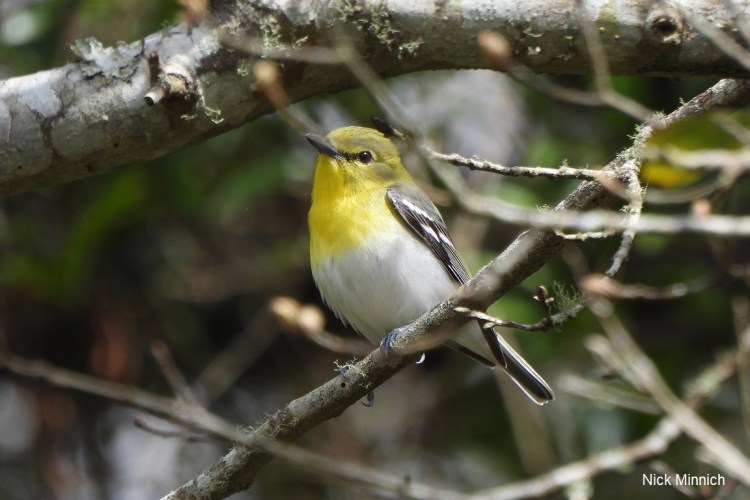
Yellow-throated Vireo (Vireo flavifrons) Family: Vireonidae By Nick Minnich, Houston Audubon Coastal Conservation Technician The Yellow-throated Vireo is one of the most striking North American vireos, with its bright yellow throat and breast plumage, broad yellow spectacles around the eyes, and gray wings with two bold white wingbars. Often, this bird frequents forest-edge habitat and […]
Dark-eyed Junco (Junco hyemalis) Family: Passerellidae By Theresa Kelly, Houston Audubon Coastal Conservation Technician This Beak of the Week has a very expansive range and an incredible array of plumages. The Dark-eyed Junco is a medium-sized sparrow, possessing the short, conical bill and rotund body shape common to its family. Their coloring varies greatly by […]
Ring-necked Duck (Aythya collaris) Family: Anatidae By Theresa Kelly, Houston Audubon Coastal Conservation Technician This week’s Beak of the Week, the Ring-necked Duck, earned both its common and scientific name (collaris) from the chestnut collar on its black neck. Decidedly difficult to make out in the field, they are better identified by other traits. The […]
By Nick Minnich, Houston Audubon Coastal Conservation Technician With 2025 fully underway, spring migration is right around the corner! Exciting vagrants are already finding their spotlight in and around our High Island sanctuaries, such as a Spotted Towhee, Red-naped Sapsucker, Hooded Oriole, and more! It’s time to start studying your field guides and strengthening your […]




 Houston AuduBlog