Hudsonian Whimbrel (Numenius hudsonicus) Family: Scolopacidae By Colleen McDonough, Houston Audubon Coastal Conservation Technician With a long, curved bill designed for catching crabs in their burrows, Hudsonian Whimbrels are a joy to watch on their wintering grounds. The species Whimbrel was recently split into Hudsonian Whimbrel and Eurasian Whimbrel based on genetic differences between American […]
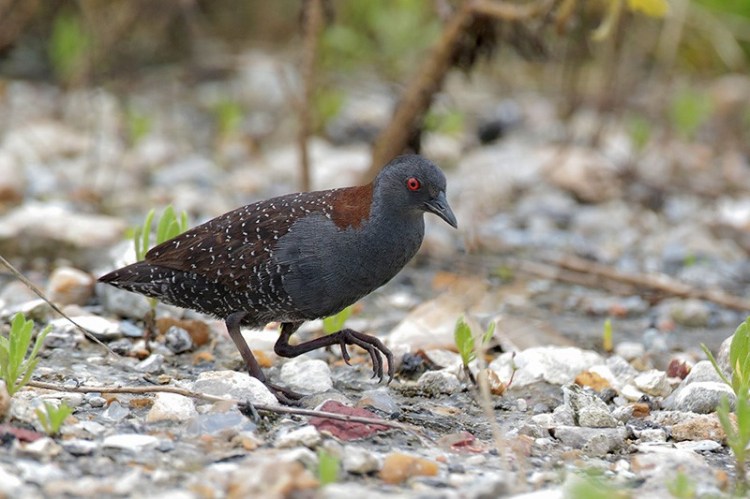
Black Rail (Laterallus jamaicensis) Family: Rallidae By Robert Buckert, Houston Audubon Coastal Conservation Technician This week’s beak is held by the smallest rail in North America. Similar in size to a sparrow, the Black Rail is one of the most highly sought-after and difficult species to spot, proving infamously elusive as it buries itself in […]
Reddish Egret (Egretta rufescens) Family: Ardeidae By Colleen McDonough, Houston Audubon Coastal Conservation Technician The Reddish Egret is North America’s rarest (and likely most eccentric) heron. An array of fast-paced and erratic hunting movements makes these birds stand out boldly among other wading species. Reddish Egrets are found almost exclusively near saltwater and brackish wetlands, […]
American Oystercatcher (Haematopus palliates) Family: Haematopodidae By Spencer Poling, Houston Audubon Coastal Conservation Technician This week’s Beak of the Week, the American Oystercatcher, is one that would be difficult to confuse with any other species in the area. Oystercatchers, family Haematopodidae, are known to frequent coasts around most of the world and for their bright […]
Loggerhead Shrike (Lanius ludovicianus) Family: Laniidae By Colleen McDonough, Houston Audubon Coastal Conservation Technician The Loggerhead Shrike, nicknamed “butcherbird”, is a songbird with unexpected carnivorous tendencies. Similar in size to a cardinal, shrikes are mostly gray with a black eye mask, hooked bill, and white wing patches visible in flight. The Loggerhead Shrike is one […]
Caroline Nixson, Volunteer Coordinator, Houston Audubon Houston may be known for its freeways and skyscrapers, but it’s also a city shaped by water, sky, and the creatures that move through both. Perched at the intersection of coastal prairie, piney woods, bottomland forest, and estuarine wetlands, the Bayou City is uniquely positioned at a vibrant ecological […]
Wyatt Egelhoff, Sanctuary Manager, Houston Audubon We’re excited to introduce everyone to a “new” Piping Plover at Bolivar Flats – “VGV” (short for ”Violet, Dark Green, Violet”)! This female Piping Plover was born in the Apostle Islands National Lakeshore (Lake Superior), Wisconsin in 2023. She returned to the area in 2024 and this past summer […]
By Schyler Brown, Bird-Friendly Communities Program Manager, Houston Audubon It’s Plastic-Free July, which means acknowledging and finding ways to reduce our plastic use and waste. Each week in July, we shared a different kind of plastic pollution and how it impacts birds and wildlife. In previous weeks, we discussed some of the different kinds of […]
By Schyler Brown, Bird-Friendly Communities Program Manager, Houston Audubon It’s Plastic-Free July, which means acknowledging and finding ways to reduce our plastic use and waste. Each week in July, we will be sharing a different kind of plastic pollution and how it impacts birds and wildlife. This week, we are talking about plastic production and […]
By Schyler Brown, Bird-Friendly Communities Program Manager, Houston Audubon It is Plastic-Free July, which means acknowledging and finding ways to reduce our plastic use and waste. Each week in July, we will be sharing a different kind of plastic pollution and how it impacts birds and wildlife. This week, we are talking about macro-plastics and […]




 Houston AuduBlog